
The one-page marketing feature published on 24 January 2025 in almost all Malayalam dailies sparked significant public outcry, prompting the newspapers to issue clarifications or apologies the following day.
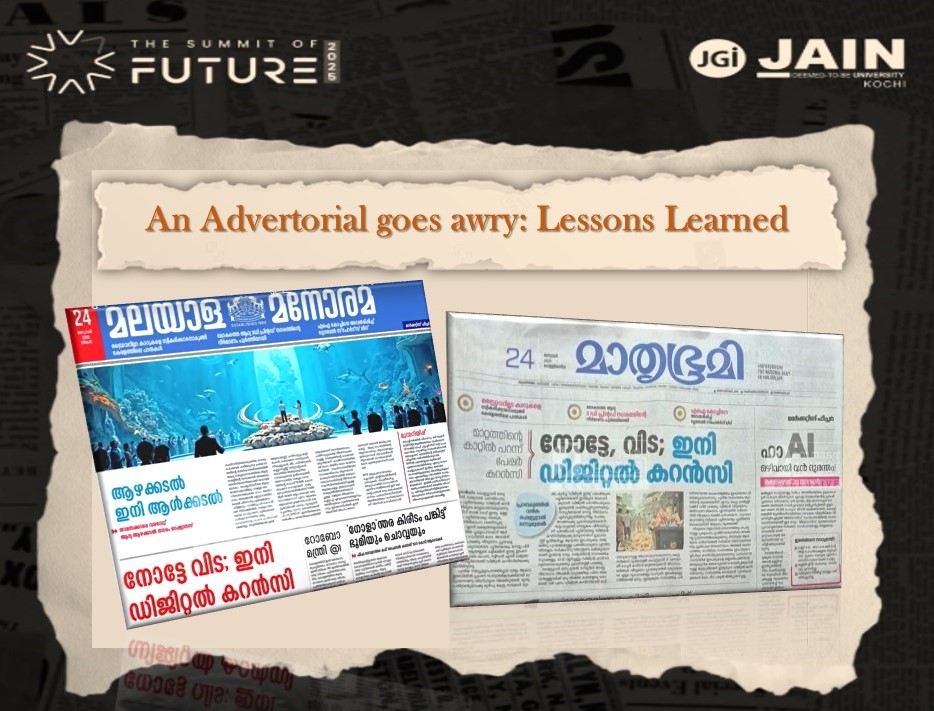
This incident serves as a live case study for marketing students, highlighting a marketing communication strategy, overlooked in marketing classrooms: Advertorial.
What is an Advertorial?
An advertorial is a form of advertising designed to resemble editorial content within a publication. The term combines “advertisement” and “editorial,” reflecting its dual nature.
Advertorial = Advertisement + Editorial
Advertorials are crafted to blend seamlessly with non-promotional content, such as magazine articles, blog posts, or news stories, while subtly promoting a product, service, or brand. Unlike traditional advertisements, advertorials aim to engage readers by offering value through informative content, helpful insights, or storytelling, making them less overtly promotional. By mimicking the tone and format of editorial content, advertorials are intended to appear neutral and unbiased, thereby encouraging readers to read the content and thus assimilate the message underlying it.
The case on our focus is that of Jain Deemed-to-be University, which organized a “Summit of the Future” and published a full-page advertorial to promote the summit.
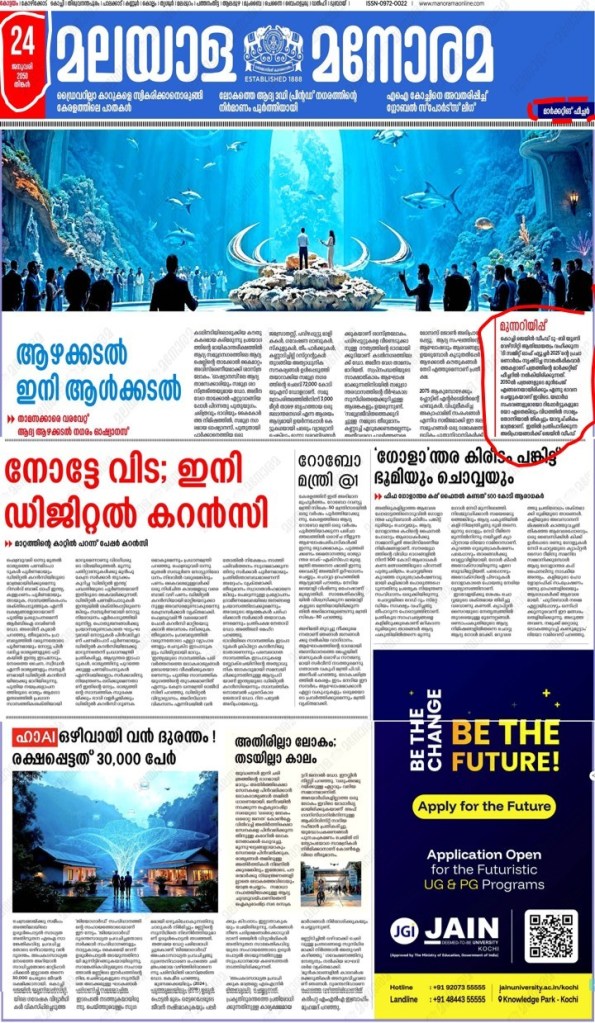

Above are the relevant pages of the two leading Malayalam dailies, Malayala Manorama and Mathrubhumi. The advertorial was thoughtfully designed, seamlessly integrating with the respective layouts and fonts of the newspapers. The designation as a marketing feature was prominently displayed at the top right, highlighted in red circles. The theme was futuristic, with the date prominently stated as “24 January 2050” in Manorama, alongside a cautionary note at the top right in Manorama and at the bottom middle in Mathrubhumi.
The content, conceptualized and written by the Jain University team, included intriguing news items such as ‘Inauguration of the first ocean city, Oceanus,’ ‘Withdrawal of paper currency to shift to digital currency from February,’ ‘Interglobal Football Cup to be shared by Earth and Mars,’ ‘First robo-minister in Kerala,’ ‘AI saves 30,000 lives from landslides through timely prediction,’ and ‘UN resolution for one world, one people, leading to a borderless world.’ These topics were undeniably captivating.
However, the advertorial sparked confusion among readers. Many initially mistook it for real news, leading to widespread panic. Upon realizing it was a marketing feature, frustration and anger followed. Social media erupted with trolls, heated debates, and derogatory remarks directed at the publications.

In response, on 25 January, Jain University in Malayala Manorama issued a clarification, that it was not a piece of news but an imaginative one as part of an advertisement by the University.

Deepika went a step further by unconditionally apologizing on 25 January.
What was intended as a creative and engaging advertorial backfired, generating a negative response that could affect future newspaper subscriptions.
One particular news item in the advertorial—regarding the withdrawal of paper currency and its replacement with digital currency from 1 February 2050—drew severe criticism. Many misinterpreted it as a policy set for 2025, triggering alarm, especially in light of the hardships faced during the 2016 demonetization of Rs 1000 currency notes. Although the news was framed as futuristic, its implications felt immediate, fueling the uproar.
Interestingly, other imaginative elements within the advertorial piqued curiosity, and upon closer inspection, their fictional nature became apparent. Many readers eventually appreciated the content and would have taken note of the theme of the summit. But the overall response underscored the risks of such campaigns, where creative marketing can easily be misconstrued, leading to a backlash.

As a corrective measure, Jain University published a full-page marketing feature on 28 January, presenting an actual report on the Future Summit. This time, the marketing feature was prominently labeled at the top right and distinguished from editorial content by a grey-bordered layout, making it clearly identifiable as an advertisement rather than an advertorial. How many of the newspaper’s subscribers would have read the page? That is the superiority of advertorials over advertisements. The subtle difference between the two carries an inherent risk of misunderstanding, which can undermine credibility and trust.
Lessons learned: A well-designed advertorial lost its impact and led to negative repercussions due to a poorly conceived and untimely piece on digital currency. Brilliant ideas/strategies can backfire due to a minor slip in the execution. This incident serves as a reminder of the delicate balance required in marketing strategies to ensure clarity and maintain audience trust.


 Stephen Musings
Leave a comment