
The movie Emergency is a biographical film about Indira Gandhi, who served as the Prime Minister of India for three terms from 1966 to 1984. The film was co-produced, written, directed, and the role of Indira Gandhi was played by Kangana Ranaut. Originally slated for release on September 6, 2024, the film’s release was delayed due to pending certification from the Central Board of Film Certification (CBFC). After several required cuts and adjustments, the movie received a U/A certificate and was released in theaters on January 17, 2025. It has been streaming on Netflix since the second week of March 2025.
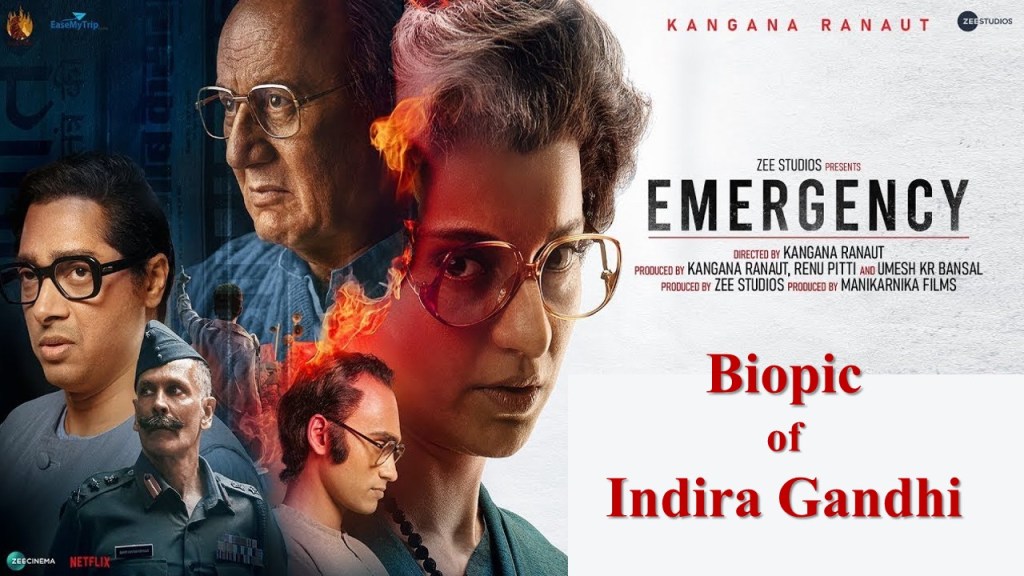
Kangana Ranaut, as the sitting BJP MP from the Mandi constituency in Himachal Pradesh, has raised genuine public concerns about the intentions behind the film and the portrayal of Indira Gandhi. While the movie briefly covers various stages of Indira Gandhi’s life—her childhood, marriage, its breakdown, and differences with Nehru—it primarily focuses on her three terms as Prime Minister of India. These terms highlight her rise to prominence, the lows she faced, and ultimately, her assassination.
Indira became India’s first female Prime Minister on the unexpected death of Lal Bahadur Shastri in 1966. The film emphasizes her second term, from 1971 to 1977, which was marked by significant action, where she experienced both her peak and her lowest moments. The 1971 India-Pakistan war, which resulted in the creation of Bangladesh, is portrayed in full detail. Known as the ‘Iron Lady’—a title bestowed by diplomat Henry Kissinger—the film shows her handling this crisis, making for a dramatic and triumphant moment in Indian history.

The victory and the euphoria it brought went to Indira Gandhi’s head. Combined with the influence of her spoiled son’s tantrums, massive strikes by railway employees, and the court’s disqualification of her election, these factors collectively led to the declaration of the Emergency. The film depicts this period in its full, harsh reality: opposition leaders were imprisoned, the press and media were censored, and the nation was under a military-style rule. This period is rightly considered the darkest chapter in the history of independent India.
The film also portrays her emotional meetings with J. Krishnamurti, the Indian philosopher, highlighting his significant influence on her life, especially in the decision to lift the Emergency in 1977. The Janata Party, a coalition of various opposition groups, came to power, marking the first defeat of the Congress Party. However, infighting within the Janata Party led to its collapse within three years, paving the way for Indira’s return to power in 1980. Having learned from her previous mistakes, she kept her son away from political affairs during her third term.
Her final term was marked by the growing insurgency in Punjab, with militants taking refuge in the Golden Temple, the holiest site for Sikhs. Her tough but crucial decision to order an attack on the temple ultimately led to her assassination in 1984 by her Sikh security guards, who had been retained despite prior intelligence warnings.
The film remains silent on the internal conflicts within the Congress during this period, with only subtle facial expressions of the cabinet ministers hinting at the tensions.
Indira Gandhi was portrayed as a relatable human being, caught between her husband and father, finding solace in her son. She was also depicted as someone haunted by her past actions, seeking philosophical guidance to cope with.

Indira’s dramatic elephant ride to the remote village elevated her image to one of grandeur. The closing poem and heartfelt song poignantly portray her as a martyr. The scene visuals were fitting, the screenplay gripping, and the dialogues sharp and impactful. Notable moments include her interactions with Nixon, Pompidou, and J. Krishnamurthi. Kangana’s portrayal of Indira was realistic—her artificial nose and adapted voice captured the essence of the real Indira Gandhi, though the makeup didn’t quite reflect the character’s true age. The most emotional scene was when Indira breaks down over a remark about her late son. While the songs added flair, they might have been more effective as background scores rather than sung by the characters.
The star cast featured Anupam Kher as Jayaprakash Narayan, Shreyas Talpade as Atal Bihari Vajpayee, Avijit Dutt as Jiddu Krishnamurti, Ashok Chhabra as Morarji Desai, Mahima Chaudhry as Pupul Jayakar, a close confidante of Indira Gandhi, Milind Soman as Field Marshal Sam Manekshaw, and Vishak Nair as Sanjay Gandhi.
Why Emergency as the title?
The title of the movie raises some questions. Why name a biopic after such an infamous event, representing the darkest period of her life? It brings to mind the biopic of Jayalalitha, the Tamil Nadu political cum film star, where Kangana played the lead role, with the title Thalaivi.
There could be three reasons for the choice of the title:
- To highlight the darkest phase of Indira Gandhi’s life, while the others were portrayed in a triumphant light.
- Since a BJP MP was involved in the making of the film, it may serve as a way to honour the Emergency period, which led to the formation of the Janata Party, the precursor to the BJP.
- Emergency, the title will serve as both a lesson and a warning for future leaders and political parties, not only in India but across the world, about the importance of safeguarding democracy.
The film’s core message conveyed through the story of Indraprastha, which Motilal Nehru, the grandfather, narrates to young Indira is: “Power corrupts, and absolute power corrupts absolutely.”

 Stephen Musings
Leave a comment