
The jokes we recall are often witty comments, sharp retorts, or clever statements that make us laugh. Many of them also carry a deeper meaning, offering food for thought. Here are a few moments from my life’s journey that I found worth sharing.

Let me begin with a memory from the early 1970s. While traveling by KSRTC bus to and from Trivandrum, the regular meal break was at the Kottarakara bus station. Passengers would invariably enter the restaurant for a meal or a light refreshment. This restaurant was operated on contract by the owner of Parklands Restaurant on College Road, Changanacherry. As I entered, a thought-provoking quote displayed at the entrance caught my attention: Man is the only animal that drinks without being thirsty and eats without being hungry. It made me pause and reflect—would someone who understood its meaning still choose to enter?
Years later, I came across an extended version of the same quote in a meaningful setting. On a tour of Thekkady, while waiting for a boat at the jetty, I noticed a hoarding of the Periyar Tiger Reserve. This version deepened the contemplation of whether man is truly superior to animals. It read: Man is the only animal that drinks without being thirsty, eats without being hungry, and makes love in all seasons. The words stayed with me, leaving me to ponder the nature of human impulses and desires.

The second moment is from the late 1970s I attended a magic show by the renowned magician P.C. Sorcar Jr., in the Lourde Matha Church Parish Hall in Kottayam. It was a once-in-a-lifetime experience. The spectacle of lights, sound, and sheer glamour made the evening unforgettable. Magicians often rely on their gift of storytelling to divert the audience’s attention from their sleight of hand, but P.C. Sorcar Jr. brought more than just showmanship.
One moment, in particular, stood out. During his act, Sorcar blindfolded himself and invited the audience to come on stage and write questions on a blackboard. The first volunteer scribbled a cheeky question—the title of a popular English song at the time: Who do you think you are fooling? Without missing a beat, Sorcar wrote his response: You, since you have paid for it. The crowd erupted in laughter. I was taken up by his quick wit and intelligence, rather than his magical skill to read through the blindfold.

In the late 1980s, Assumption College, a women’s institution managed by the same administration as St. Berchmans College, where I worked, introduced a BSc Computer Science degree program. One day, the principal, Rev. Sr. Maria, called me and requested that I teach the Accountancy paper to them. I hesitated, explaining that I didn’t teach accountancy, and suggested she assign someone from the department instead. However, she was firm in her decision. “You need not send any other teacher,” she insisted.
At her persistence—and with permission from the principal of St. Berchmans—I agreed to take the classes at Assumption College. I later realized that her insistence stemmed from the trust she had in me, possibly influenced by the fact that my wife was a faculty at Assumption.
One day, while discussing a theoretical concept in class, I moved on to its limitations and remarked, “There is nothing in this world without limitations” To emphasize the point, I posed a question to the students: “Can anyone name something in this world that has no limitations?” The answer from one student took me by surprise—and it will surprise you too. She simply replied, “Our imagination.”

One of my colleagues had to bring his son, a first standard student to college since his school was on holiday and his wife had other engagements to attend to. The boy spent his time with his dad in his room and when he had to engage in class the other members of the faculty and the office staff took care of him. He got friendly with all and in short, he had a jolly good time.
The next day when it was time to go to school, he said to his dad “I don’t want to go to school, I shall go to college”

I joined the Faculty of Commerce at St. Berchmans College, Changanacherry, in 1977. The next chapter in my life was marriage, and the best option seemed to be finding a match from the faculty at Assumption College, the women’s college under the same management, the Archdiocese of Changanacherry. I was fortunate to marry one of the faculty members at Assumption. Thus, I became part of a small group of SB faculty who had their spouse at Assumption College.
St. Berchmans College and Assumption College are considered sister institutions due to their shared management. However, for us, they represent our spouses’ institutions. Over the years, many students from both colleges have married one another. SB and Assumption colleges in India and abroad have a common alumni/alumnae association to accommodate spouses from both colleges. [S B and Assumption colleges have become mixed colleges since the 2024-25 academic year]

After I got married in 1982, I had three children by July 1987. One of my cousins, who had moved to the US in 1983, returned for his first visit by the end of 1987. Upon seeing the number of children, he jokingly asked, “How many should I expect on my next visit?” While it may have seemed like a playful use of statistical extrapolation, such predictions don’t always hold true.
Just to keep you updated, the number of children has remained steady at three, and after 43 years of our marriage, we now have eight grandchildren.

I was the fourteenth principal of St. Berchmans (2007-10) and the first layman (non-Reverend father) to hold the position. Naturally, visitors expecting to meet the principal often anticipated someone in a cassock. On one of my early days in the role, a visitor, caught off guard, hesitantly asked, “You’re not a Father?” With a smile, I replied, “Yes—father of three children.”
At an official function at St. Thomas Nursing School, Chethipuzha, where Rev Fr John Thekkekara was the Director (currently the Vicar General of Archdiocese of Changanacherry) I was presented with the book The Accidental Prime Minister: The Making and Unmaking of Manmohan Singh by Sanjaya Baru. The title intrigued me, and in a conversation with former principal Rev. Dr. George Madathilparambil, I jokingly remarked, “I am the accidental principal of St. Berchmans.” Without missing a beat, Fr. Madathilparambil responded with a smile, “You are the providential principal.”

During my second stint at St. Berchmans College as the Director of the MBA program (2014–2020), I experienced one of the most enjoyable phases of my career.
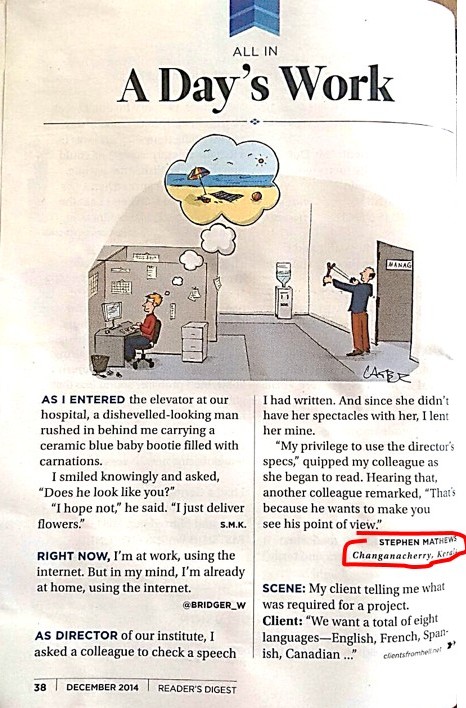
One evening, as the faculty were wrapping up for the day, I met a few of them in the lobby outside my office. I asked one of them to review a speech I had written. Since her spectacles were in her bag, I handed her mine. As she put them on, she quipped, “My privilege to use the director’s specs.” Hearing this, another faculty member chuckled and added, “That’s because he wants to make you see his point of view.” [The anecdote was published in Readers Digest, in December 2014. A copy given at the bottom]

Early 2023, on a referral, I visited a medical college hospital in Trivandrum, carrying pages of medical reports and documents. However, the doctor we met set aside all the paperwork and first asked us to describe the illness and its progression in our own words.
As I explained, my wife also chipped in, adding her perspective. This conversation went on for nearly half an hour before the doctor even glanced at the reports. She then carefully reviewed them and unhurriedly explained the condition and the treatment plan she intended to follow. Before leaving, I remarked with a smile, “Doctor, I must say—you are truly ‘the patient.’ You patiently listened to us without any haste or interruption.”

This happened in early 2024. At the time, I had difficulty navigating steps but could still drive. One day, my wife and I went shopping. After parking the car in front of the store, we finished our shopping, but I needed assistance to step down from the entrance.
A kind autorickshaw driver, who also supplied drinking water in containers, noticed and voluntarily offered to help. As we neared the car, he paused to decide which side to assist me from and casually asked, “Who’s the driver?” When my wife pointed to me, his spontaneous reaction said it all. With a look of astonishment, he simply exclaimed, “Amazing!”


 Stephen Musings
Leave a reply to stephen mathews Cancel reply