
Donald Trump, the newly elected 47th President of the United States, has engaged in a series of rapid and numerous actions, often perceived as unusual and unpredictable. Evaluating his actions effectively requires adopting a specific lens—one that allows us to understand the journey the world and its nations have undertaken and where they are headed. The perspective/lens for this purpose is shaped by the principles outlined in Stephen R. Covey’s seminal book, The 7 Habits of Highly Effective People.

In his influential book, The 7 Habits of Highly Effective People, Stephen R. Covey anchors the seven habits on three fundamental stages: Dependence, Independence, and Interdependence. He describes a journey of personal growth that transitions from reliance on others (Dependence) to self-sufficiency (Independence) and ultimately to collaboration (Interdependence), which marks true maturity.
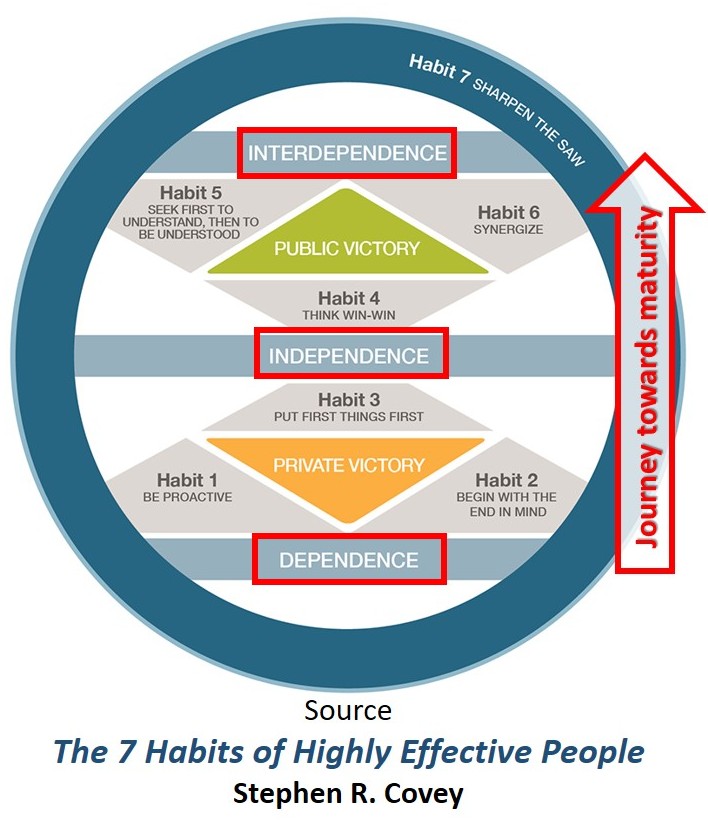
This framework can also serve as a benchmark for evaluating the progress of nations. The global historical journey follows the same three key stages: dependence, independence, and interdependence. On a broader scale, we, as human beings should aspire to advance toward an age of wisdom—an evolution of data, information, and knowledge that fosters sound judgment.
The concept of interdependence, placed at the top, parallels the loftiest Vedantic teaching from the Maha Upanishad, Vasudhaiva Kutumbakam, which means “the world is one family.”
Let’s go through these stages in our history
Age of Colonisation leading to dependence
Setting aside the ancient dynasties that expanded their rule through conquests, the modern nations we recognise today initially asserted dominance over other regions, turning them into colonies. Colonialism, defined as “control by one power over a dependent area or people,” resulted in widespread dependence by the colonized regions.
The roots of colonization trace back to the Age of Discovery. Beginning in the 15th century, Portugal sought new trade routes and civilizations beyond Europe. In 1415, Portuguese explorers conquered Ceuta, a coastal town in North Africa, marking the start of an empire that lasted until 1999. Western European nations quickly followed suit—England, the Netherlands, France, Spain and Germany expanded their own overseas empires. By 1914, a vast majority of the world had experienced colonization by European powers, thus making them to be in a state of dependence.
Age of decolonisation leading to independence
In 1776, the American colonies declared independence from Great Britain, marking the first major decolonisation event. In the early 19th century, Latin American nations such as Argentina, Mexico, and Venezuela also gained independence from Spain. After World War II, decolonisation movements gained significant momentum by the mid-20th century. Many African, Asian, and Caribbean colonies achieved independence through political struggles. Key milestones include:
- 1945–1946: The Philippines gained independence from the United States.
- 1947: India and Pakistan gained independence from Britain
- 1950s: Indonesia secured independence from the Netherlands.
- 1997: Hong Kong was returned to China by the United Kingdom.
By 1999, nearly all former colonies had gained independence, marking a global shift toward sovereignty and self-governance.

Globalisation leading to Interdependence
Independence is only a stepping stone. True maturity, as Covey describes, or a wiser perspective at the national level, involves moving toward interdependence. On a global scale, this means nations recognizing one another, engaging in mutual cooperation, and fostering exchanges that yield outcomes greater than the sum of individual nation’s efforts. Globalisation emerged as the movement embodying this principle. In simple terms, globalisation refers to the increasing interconnectedness and interdependence of people worldwide—an evolution in reasoning where nations collaborate to achieve shared goals.
Globalisation gained significant momentum in 2001 when China joined the World Trade Organization (WTO), opening the door for multilateral agreements. This period saw an accelerated transfer of capital, goods, technology, and labor across the globe. Multinational corporations thrived, and outsourcing became a global norm.
The World Economic Forum’s 2019 annual meeting, themed “Globalization 4.0,” shifted focus to emerging technologies like artificial intelligence, as well as pressing non-business issues such as climate change, inequality, and empowerment of women.
One of the most remarkable and unexpected developments was the signing of the Abraham Accords in 2020, an agreement between historically adversarial Arab nations and Israel. Named after their common patriarch, the accords symbolised a profound step toward peace, security, and prosperity in the Middle East and beyond. This was followed in 2021 by the I2U2 initiative, a strategic collaboration between Israel, India, the UAE, and the United States. The initiative aims to enhance cooperation in technology, trade, climate action, energy, food security, and regional stability.
However, several major events, in recent years, disrupted this trajectory toward deeper international collaboration:
- Russia’s invasion of Ukraine in February 2022—partly driven by Ukraine’s NATO ambitions—has reshaped global geopolitics.
- Hamas-led attack on Israel on October 7, 2023, with the underlying aim to disrupt the Abraham Accords.
- January 2025, the newly elected 45th U.S. president, Donald Trump introduced significant shifts in American foreign policy, affecting globalization and international alliances.
If the first two events resulted from authoritarian and extremist actions, the third is particularly concerning as it is backed by the world’s largest democracy. Does this indicate a regression in human progress, or does it expose fundamental flaws within democracy itself?
Trump 2.0’s election campaign theme, “Make America Great Again” (MAGA), represents a clear step backward in the global pursuit of progress and maturity. On assuming office Trump’s policies on quitting WHO, enhancing import tariffs, and his harsh deportation measures highlight his disregard for international relations. His ambitions to assert control over Greenland, the Panama Canal, and the Gaza Strip echo the era of colonial expansion, raising questions about the future of global tranquility.
On a positive note, this can be viewed as a correction in stock market terms, as history steadily advances toward an ideal stage of openness, freedom, and interdependence/world is one family. With time, we will draw ever closer to this vision, for we are part of an ongoing journey—a work in progress.
A Prayer for the Ideal World Order
Let us join Rabindranath Tagore’s timeless prayer for his nation, now echoed for the world:
“Where the world has not been broken up into fragments by narrow domestic walls…
Into that heaven of freedom, my Father, let the world awake.”


 Stephen Musings
Leave a reply to crispy9cd8503cb2 Cancel reply