

On September 1, 2024, the Aero Lounge at Cochin Airport was inaugurated. It is the largest of its kind in the country, marking another milestone in Cochin International Airport Ltd (CIAL)’s journey.
Here is a short narration of CIAL’s journey.
In 1991, India boldly adopted a new economic policy called Liberalisation, Privatisation, and Globalisation (LPG), signaling a departure from the inefficient public sector. As a result, most sectors were opened up to private investment. In 1993, Cochin recognized the imperative for expansion, moving beyond its reliance on a small airstrip at the Naval base on Wellington Island for air travel. When the Airport Authority of India was approached for the airport expansion, it bluntly expressed its inability to take on a Greenfield airport project. In response, Kerala’s Chief Minister, K. Karunakaran, decisively assigned the task of establishing a new airport to V. J. Kurien, IAS, the Ernakulam District Collector.
With strong support from the Chief Minister, Kurien made daring moves to establish an airport at Nedumbasserry, 28 kilometers from the city. The project required substantial funding, and to raise the necessary amount, Kurien launched a public company, gathering funds from the government, financial institutions, and the public, especially Non-Resident Indians (NRIs) who would benefit from the airport. Since there was no precedent for such an initiative, new laws and procedures were created to achieve the objective.
This led to the establishment of Cochin International Airport Ltd., a public limited company, in 1994. It became India’s first Public-Private Partnership (PPP) venture. Kurien faced a multifaceted challenge: raising funds, securing approvals from various agencies, acquiring land, constructing the necessary infrastructure, appointing staff, and overcoming opposition from local landlords and political leaders. He successfully crossed the initial hurdles and the airport commenced operations in 1999.
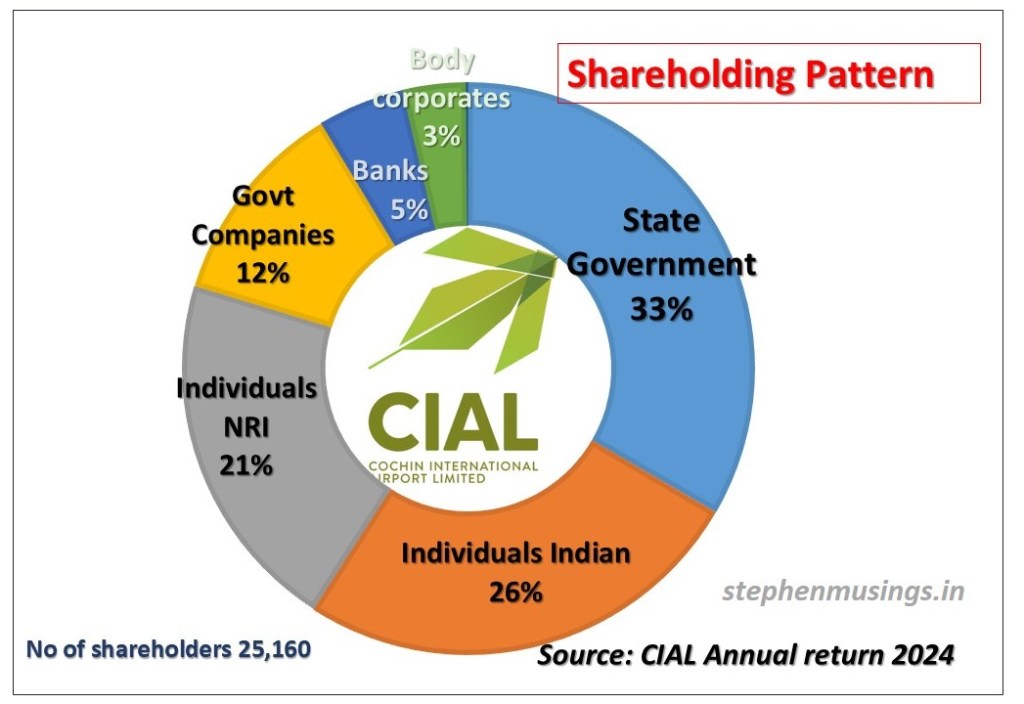
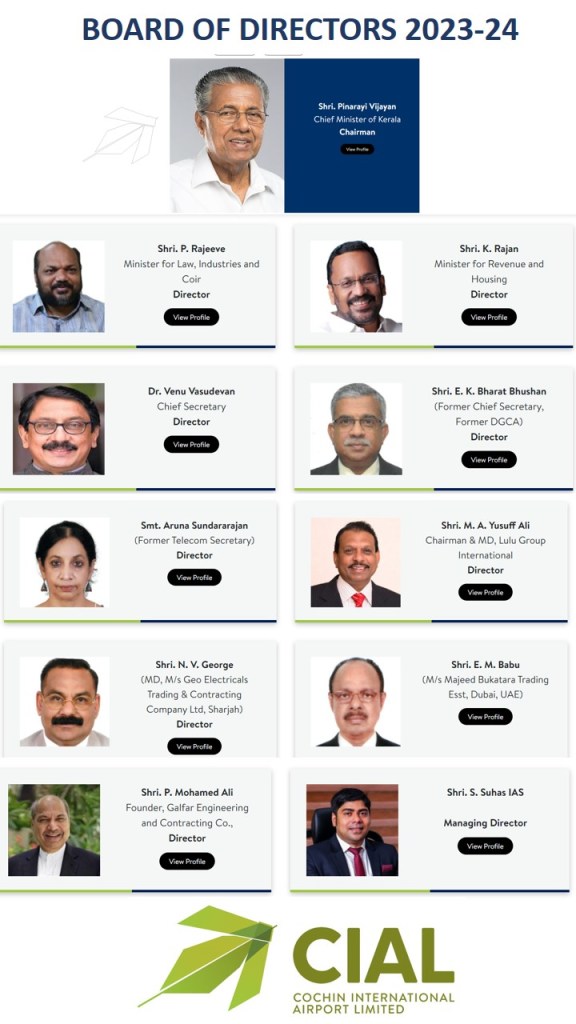
CIAL is not a government company, since its shareholding is less than 51%, but the government still maintains control through its larger stake. The Board of Directors is a mix of government officials and private investors. The Chief Minister serves as the Chairman, an IAS officer as the Managing Director, two state cabinet ministers, a chief secretary, two government nominees, and four representatives of the investors. This is practically an erstwhile government company but is entrepreneurial and business-like with a due representation for individual investors on the board. The Kerala Chief Ministers who followed, from both the left and right coalitions, who alternated as Chairman after each election, consistently supported the company.

This collaborative approach has been highly successful, with the airport turning profitable and paying dividends since 2003-04. The latest dividend paid in 2022-23 was 35%, bringing the cumulative dividend payout over 24 years to 317%. That is to say, the shareholders have received dividends three times the investment they made in CIAL shares.
The significance of this organization can be assessed by the fact that CIAL became a case study at the top international business school at Harvard, as well as at national business schools IIMA and IIMK.
In addition, the airport has won numerous accolades and awards. Cochin International Airport gained major international recognition in 2015 when it became the world’s first fully solar-powered airport. In 2017, it also became the first airport in the world to implement a solar carport, a parking bay with rooftop solar panels. The airport was named “the best non-metro airport in India” in 2016 by the Air Passengers Association of India. In July 2018, the airport received the Champion of the Earth award, the highest environmental honour instituted by the United Nations.
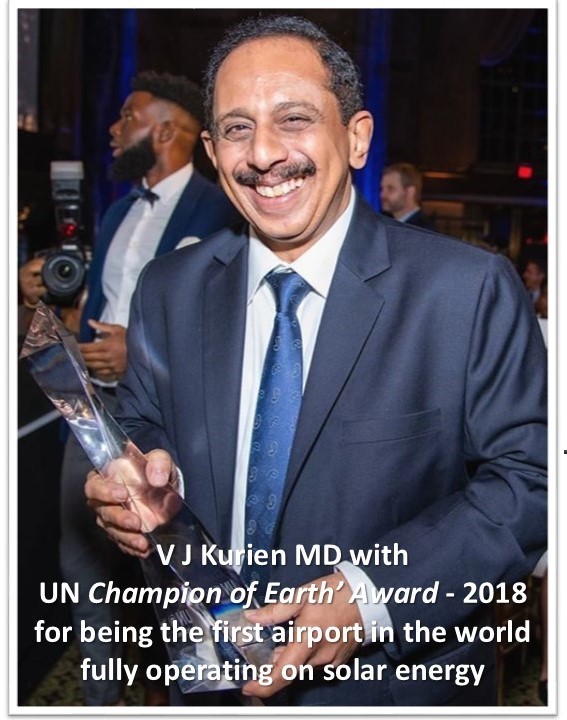
V. J. Kurien served as the Managing Director from the airport’s inception until his retirement in June 2021, a total of 19 years in three terms, including five years after his retirement in 2016. Kurien’s role in CIAL’s saga is highlighted by the case study by IIMK. To read the case study click here.
CIAL continues the winning streak under MD Mr. S Suhas IAS
Mr. S Suhas IAS assumed the position of Managing Director in July 2021 and has been instrumental in leading CIAL to new heights. Kochi Airport has also achieved the distinction of being the fourth airport in the country to have a business jet terminal launched in 2022, focusing primarily on charter operations. This terminal is the largest of its kind in India and ranks third, after Delhi and Bengaluru, in terms of the highest number of flights landing at this facility. The newly added Aero Lounge, spanning 50,000 sq. ft, is the largest in India and was inaugurated on 1st September. The latest annual report for 2023-24 shows an overall performance increase of almost 30% compared to the previous year.

We salute the team on the board for this achievement.
CIAL vs Adani Trivandrum airport
When the expansion plan for Trivandrum airport was proposed, the state government offered to manage it under the CIAL model, but this was rejected by the central government. Instead, the Union government pursued the Public-Private Partnership (PPP) model and invited quotations from interested parties. The Airport Authority of India called for bids based on the per-passenger fee for domestic travelers. Only three parties participated, including those with no prior experience in the field. GMR offered ₹63 per passenger, KSIDC quoted ₹135, and Adani bid ₹168. As the highest bidder, Adani won the contract to operate, manage, and develop the airport for fifty years, after which it would be transferred to the government.
In a surprising turn of events, with the approval of the Airport Economic Regulatory Authority (AERA), Adani Trivandrum International Airport, starting July 1, 2024, has increased the user development fee (UDF) [interesting name for the charge on passengers] by 50%, raising it from ₹506 to ₹770 for domestic travelers for one year, with further increases planned each year. The irony is striking: a bid awarded based on a payment of ₹168 per passenger to the government now allows the collection of ₹770 from the passengers.
Inauguration of 0848 Aero Lounge
At the inaugural meeting on 1 September 2024, Chief Minister Pinari Vijayan mentioned the increased UDF at Trivandrum airport. He pointed out that private operators, who have taken over the airport, have been imposing higher user development fees which ultimately burdens the ordinary passengers. In contrast, with the government holding a majority stake, CIAL has not attempted to impose a burden on the common passenger. The airport charges the lowest user fee in the country. The government intends to support business establishments in a way that benefits the common people.
This statement by the CM highlights the main difference between the CIAL PPP model and the PPP model now adopted by the central government for all infrastructure projects in the country.
During the inaugural ceremony on September 1, 2024, CIAL employees made a generous donation of ₹1 crore to the Chief Minister’s Distress Relief Fund for the rehabilitation in Wayanad, while cargo workers contributed ₹50,000. These significant contributions demonstrate the substantial size of the workforce and their financial well-being. This exemplary gesture showcases the positive impact that successful business enterprises like CIAL can have on societal needs and welfare.
Warning Bell
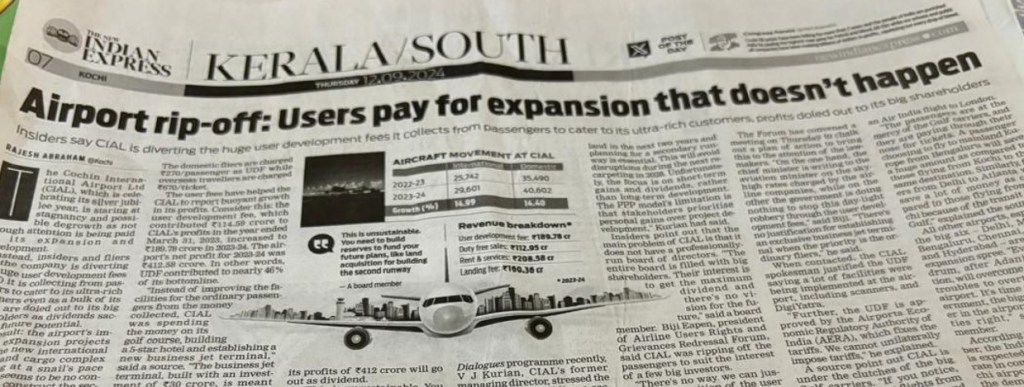
The above newspaper report exposed a few management practices at Cochin International Airport Limited (CIAL), which are of great concern. The company allegedly misallocates the substantial User Development Fees (UDF) collected from passengers to benefit its affluent passengers. It deals out hefty dividend payouts to major shareholders, rather than reinvesting in the airport’s future growth. This short-sighted approach neglects the required reserve funding for critical projects, such as land acquisition for a second runway.
The Airline Users Rights and Grievances Redressal Forum has raised several pressing issues, including:
– Lack of direct flights from Kochi to mainland Europe and the US, except for a single Air India flight to London
– Inadequate expansion efforts compared to other major airports, including Delhi, Mumbai, Bengaluru, Chennai, Kolkata, and Hyderabad
– Trivandrum Airport’s potential to surpass Kochi Airport after Adani’s acquisition
A board member warned, “It’s time for the state government, the airport’s largest stakeholder, to reassess its priorities.” As the Indian aviation sector is poised for rapid growth, Kochi Airport risks being outpaced by competitors if it fails to capitalize on increasing demand. The warning bell has sounded, urging corrective action to ensure the airport’s sustainable development and competitiveness. To read the newspaper report, click here.

The CIAL logo is a powerful emblem that reflects the organisation’s essence. The symbol, crafted from the tender leaf of a coconut tree, is a tribute to Kerala’s rich cultural heritage and traditional decorative art. The clever design seamlessly integrates the image of an airplane and an upward-pointing arrow, signifying a forward-thinking and futuristic approach. The logo represents the ingenuity and potential of Kerala, showcasing what the state can achieve through innovative spirit and dedication.
_____________________________________
Harvard Business School case study published in 2001 describes in detail the establishment of the airport at Nedumbasserry and raises a critical question: will it survive? Click here to read the full study.
The 2001 case study from IIM Ahmedabad highlights the project’s political, revenue, operational, and regulatory risks. Click here to read the case study.


 Stephen Musings
Leave a reply to Ciby Cancel reply