
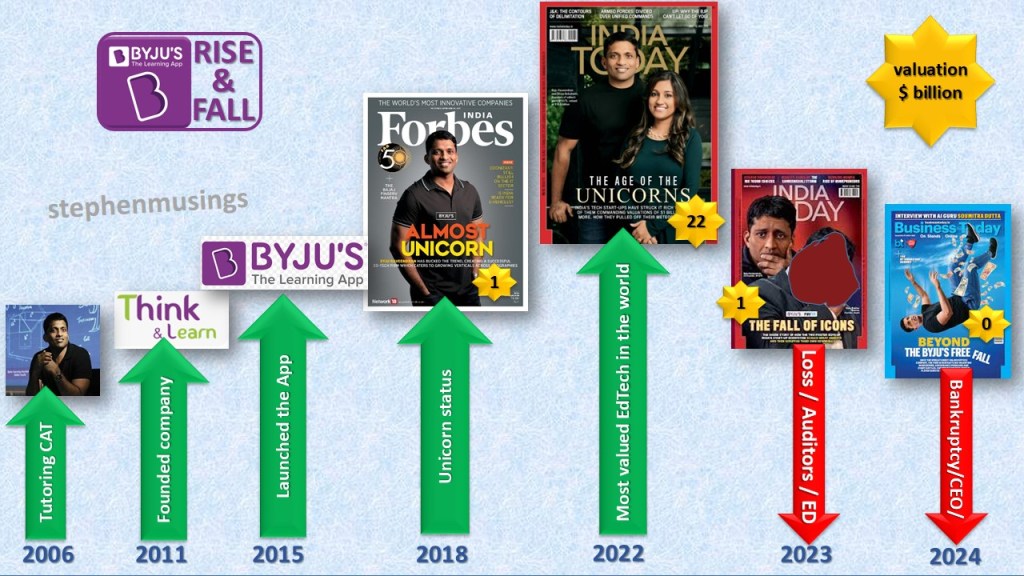
As we go through the narrative of Byju’s, a pressing question emerges: What attracted esteemed investors from across the world to Byju’s?
Byju Raveendran’s journey began in 2006 when he gained recognition for tutoring peers for the CAT, India’s most challenging entrance examination. The outstanding achievements of his students garnered national acclaim, prompting the expansion of his classes to multiple cities. Byju’s exceptional talent for simplifying complex concepts and facilitating student comprehension enabled them to clear the formidable CAT hurdle. This success propelled him to co-establish Think and Learn Pvt Ltd with his wife Divya Gokulnath in 2011. The company’s celebrated core competency, as emphasized by endorsements from Sharukh Khan and Mohanlal in their advertisements, was their ability to make students “fall in love with learning,” marking a significant shift in the educational landscape. This competence, coupled with India’s vast education market, enticed Aarin Capital, Sequoia, Chan Zuckerberg Initiative, Tencent, and other investors from around the globe to invest over $ 5 billion in Byju’s.

Byju’s currently faces multifaceted challenges encompassing revenue, governance, legal issues, employee concerns, and organizational matters. In February 2024, Byju’s shareholders, including certain investors, opted to remove Mr. Raveendran from his CEO position. Raveendran has initiated legal proceedings to contest this decision. This situation draws parallels with the initial CEO transitions observed at tech giants like Apple and Google.
Apple story: At the tender ages of 21 and 27, respectively, Steve Jobs and Steve Gary Wozniak embarked on the journey of founding Apple in 1977, starting out in Jobs’s garage. Recognising their own lack of expertise, they appointed Michael Scott, then 33 and serving as Director of Manufacturing at National Semiconductor, as CEO. However, it was in 1983 that Apple made a significant change, bringing John Sculley, then 44 and the president of PepsiCo, Inc., to lead the company as CEO. Sculley’s initial reluctance to depart from Pepsi and embrace the unfamiliar realm of technology was met head-on by Jobs’s famously provocative query, “Do you want to sell sugar water for the rest of your life, or come with me and change the world?” This iconic quote underscores Jobs’s persuasive prowess and highlights his steadfast conviction in Apple’s transformative mission. Sculley’s arrival signaled a pivotal leadership transition and positioned him as Jobs’s mentor in managing a growing corporation.
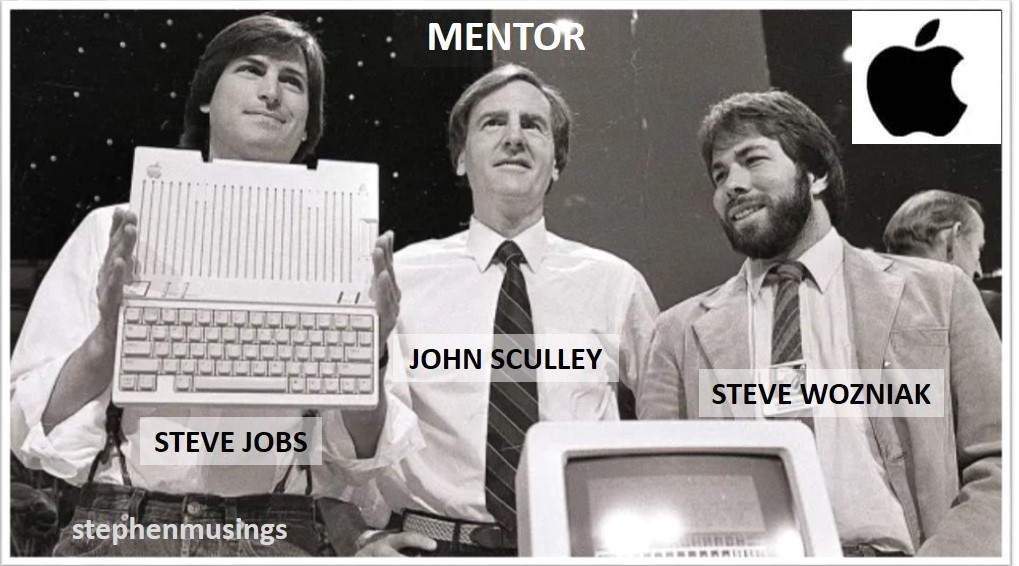
A dramatic turn occurred in 1985 when a power struggle between Jobs and Sculley led to Jobs parting ways with the very company he had co-founded. Yet, fate had an unexpected twist in store. In 1996, Apple acquired NeXT, the company Jobs had established after his departure, leading to his eventual return to assume the role of CEO at Apple. From that point until August 2011, Jobs steered the company with his visionary leadership. Tragically, his tenure was cut short by a terminal illness, and he passed away in October 2011, leaving behind a legacy that forever altered the technological landscape.
The removal of Jobs from Apple is viewed by some as the negative consequence of selecting an outsider as CEO. However, in his renowned ‘Connecting the Dots’ address at Stanford in 2005, Jobs expressed, “Being fired from Apple was the greatest thing that could have occurred to me.”
While Jobs will forever be revered as the visionary founder and driving force behind Apple, his tenure as CEO spanned only fifteen years, a period that began when he reached the age of 40. Jobs, often hailed as the icon of entrepreneurship recognized the value of appointing an experienced individual to lead his company.
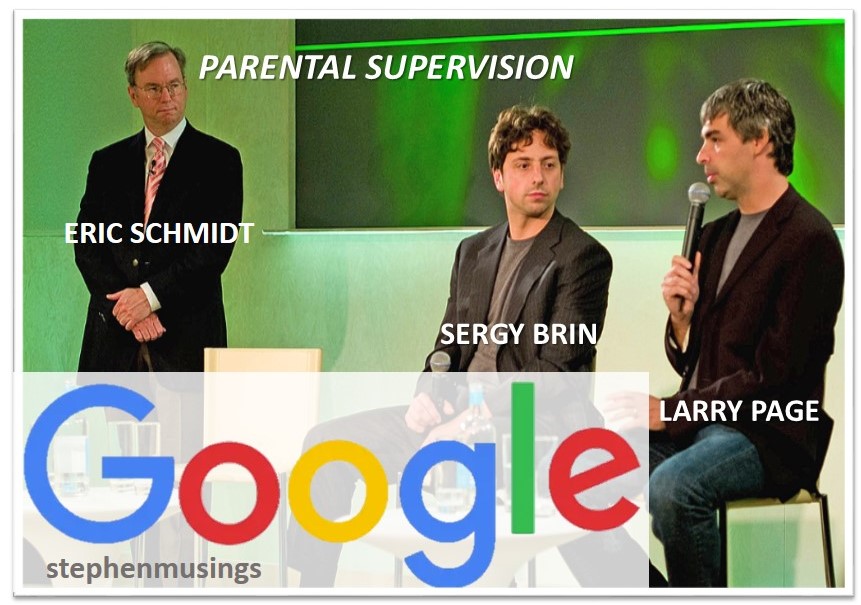
Google Story: Established in 1998 by Stanford University PhD scholars Larry Page (25) and Sergey Brin (25) in California, USA, Google initially received funding from venture capitalists. By 2001, during a financing round, Sequoia advised Brin and Page to bring on board a CEO. They agreed and appointed 46-year-old Eric Schmidt from Novell as Google’s CEO. Larry Page assumed the position of president of products, while Sergey Brin operated as president of technology. This setup was termed “parental supervision” by the duo. Schmidt remained as CEO until 2011, when Page assumed the role until he passed the baton to Indian-born Sundar Pichai in 2015. Though Larry Page and Sergey Brin were the founders, they did not hold the CEO position, except for five years by Page. [Page was the CEO of the parent company Alphabet from 2015 to 2019]
Byju’s story: The significant question that emerges is why Sequoia, the same investor that advocated for the appointment of an experienced CEO when investing in Google in 2001, did not follow the same approach when investing in Byju’s in 2013. Had Byju Raveendran, either under investor pressure, akin to Google, or of his own volition, akin to Jobs, brought in another seasoned individual as CEO—perhaps as a ‘mentor’ or to provide guidance—he could have directed his focus toward enhancing his product/app. Instead, with over $5 billion in investor funds at his disposal, Byju embarked on reckless spending, particularly in promotion, marketing, and acquisitions. These tendencies could have been curbed or executed judiciously with an experienced leader at the helm. However, even as the company faces challenges, Byju Raveendran adamantly clings to the CEO position, despite shareholders, including investors, deeming him unsuitable for it.
The news from the industry is that Byju’s downturn has affected the business of all players in this edtech segment.
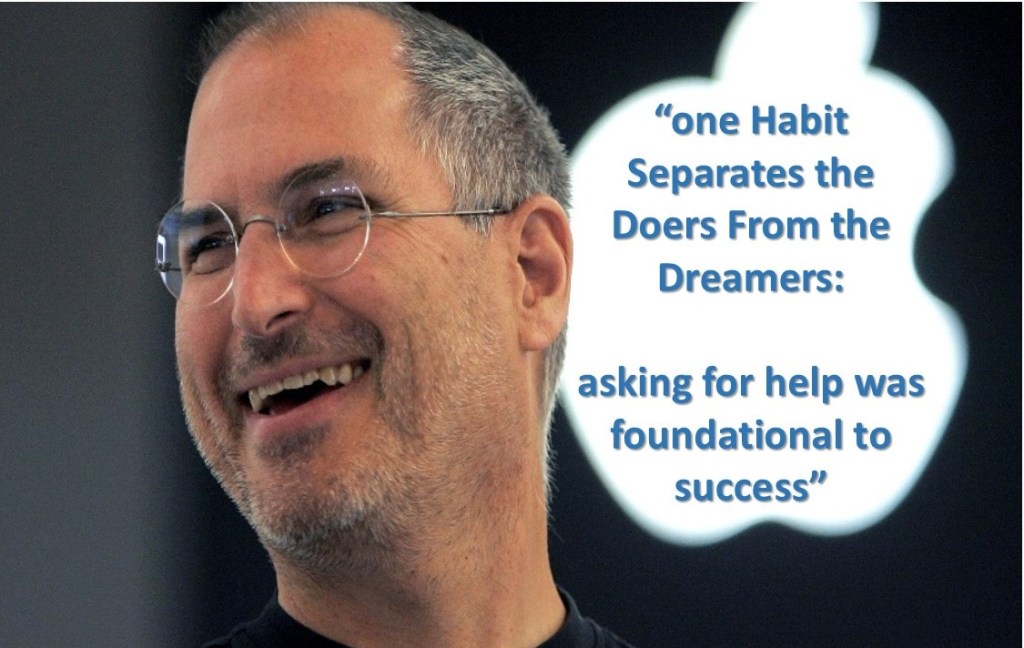
The contrasting tales of the glorious success of Apple and Google and the inglorious fall of Byju’s offer a crucial lesson for all entrepreneurs/startups, both present and future. Founders, often young and filled with vision and passion, should be willing to entrust the leadership of their organization to an experienced, seasoned individual.


 Stephen Musings
Leave a reply to stephen mathews Cancel reply