
Flashback: The Israelites found themselves surrounded by numerous adversaries, one of which was the Philistines, with whom they engaged in multiple conflicts. In 1025 BC, as both sides prepared for battle, a towering giant named Goliath, measuring nine feet nine inches in height, issued a challenge to the Israelites, daring them to send forth a champion. David, a mere 15-year-old shepherd boy standing at a modest five feet in stature, accepted the challenge. Armed with his familiar tools—a sling and a stone—David took precise aim and struck Goliath squarely on the forehead, bringing down the giant. This iconic event exemplifies the triumph of a diminutive opponent over a formidable adversary.
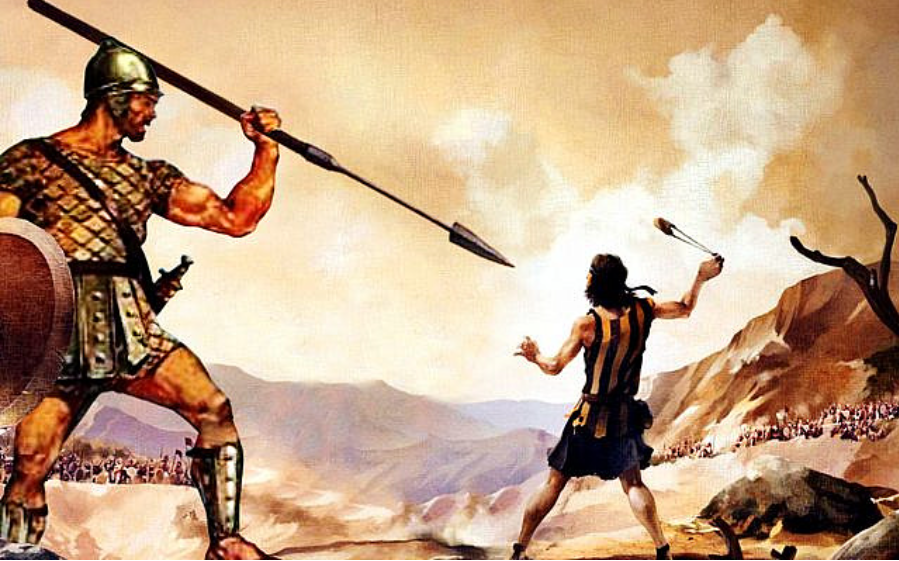
The present: In the third millennium, the duel is being enacted on new dimensions, with the involved parties assuming different roles. The once modest David has evolved significantly in terms of economic strength, intellectual prowess, innovation, global influence, and overall prosperity. It now stands as a Goliath in comparison to its opponent. While the original duel occurred in a remote locale, witnessed by a select few, today it unfolds before the entire world, with round-the-clock, live coverage by countless media outlets.
Back then, there were only two stakeholders; today, the number of stakeholders has grown exponentially. In fact, it’s more appropriate to ask, “Who isn’t claiming a stake in this current encounter?” The consequences reverberate globally, given that this issue has spanned over three millennia, progressing from a family feud to a series of invasions, world wars, UN interventions, and the involvement of powerful nations. The scope of matters covered includes humanitarian concerns, religion, terrorism, progress, economic development, and collaborative efforts. This is not just a physical conflict but rather involves mental, psychological, and ethical tussle.
Throughout this extended period of three millennia, human history has transitioned from stages of barbarism and kingdoms to the prevalence of democracy in a vast majority of countries.
The issue is so intriguing that it often eludes the understanding of the common person. Nevertheless, individuals, driven by their emotions and capacity for independent thought, are influenced to adopt positions in this conflict. The stance one assumes is heavily influenced by their personal beliefs, the religion one adheres to, their allegiance to a particular political party, and their choice of media consumption.
In a world where every individual freely expresses their viewpoints, there is a demand for onlookers to align themselves with one side or the other, akin to the spectators of gladiators in an arena locked in combat. Paradoxically, this can sometimes result in more harm being inflicted on the spectators than on the actual players involved. The reality is that in the complexities of real life, there are no clear-cut black-and-white distinctions as in a chessboard, but rather a vast gray area, shrouded in ambiguity and uncertainty.
Let’s refrain from taking sides and spreading our skewed perspectives that will only exacerbate the problem at hand. We all yearn for peace and let us not hinder its attainment.
At most, we are left with inquiries to which we, as individuals, lack responses. Should those with power and influence be allowed to dictate outcomes? Must we cling to past grievances and constantly seek retribution? Shouldn’t we protect the rights of the vulnerable? Ought not the people set aside their differences and unite for the greater good? Is it acceptable to rationalize current injustices by invoking historical precedents? Can democracy, which is meant to be a system of governance by the people, for the people, and of the people, provide a remedy in such circumstances? Or does democracy face a threat in such situations? Is war an answer for terrorism? Is lasting peace achievable in this region? Has the United Nations lost its relevance? Are there no global leaders capable of mediating and fostering consensus? …………….



 Stephen Musings
Leave a reply to stephen mathews Cancel reply