
The transformation of the British East India Company into the Indian East India Company is undeniably captivating. It involves recounting a historical saga that stretches over four centuries. Let’s commence the narrative right from its beginning. The initial segment is a ‘recap’ of what we learned from our high school history textbooks.
Genesis: In the year 1600, Queen Elizabeth, the first, of Britain issued a charter to establish “The Governor and Company of Merchants of London Trading into the East Indies.” This marked the birth of the first joint-stock enterprise, the ‘East India Company’, subscribed by 250 investors. The company received royal endorsement, granting them an exclusive trade monopoly for commodities originating from the East Indies, regions extending beyond the Cape of Good Hope. Moreover, the company was authorized to wield authority in the name of the English Crown. [Five more East India Companies were chartered by European nations, specifically the Netherlands, Denmark, Portugal, France, and Sweden]
Glimpse of the Company’s Engagements
In 1613, the Company established its first factory in Surat, Gujarat. Subsequently, it erected trading centers in Madras in 1639, Bombay in 1661, and Calcutta in 1690, which served as the genesis of these bustling metropolises.
Engaged in trading a diverse array of commodities including gold, silver, tea, coffee, pepper, other spices, calico, cotton, silk, opium, and more, across the Persian Gulf, China, and various parts of Asia. The Company held sway over nearly half of the global trade.
The Company’s military forces achieved triumphs in India, prevailing over rival factions from France, Netherlands, and Portugal. The company’s army also secured victories against indigenous rulers in multiple regions of India. A standout instance was the pivotal Battle of Plassey in 1757, where EIC soldiers under the leadership of Robert Clive emerged victorious against the Nawab of Bengal’s troops.
Through territorial acquisition, the Company established dominion over vast expanses of land. However, this ascendancy drew concern from the British government, leading to the enactment of successive laws and acts aimed at curbing the Company’s authority. Ultimately, in 1858, the British Government terminated the Company’s rule, culminating in the dissolution of the East India Company by 1874.
The epitaph in The Times on the East India Company reflects its historical role: “It accomplished a work such as in the whole history of the human race no other company ever attempted and as such is likely to attempt in the years to come”

New Avatar
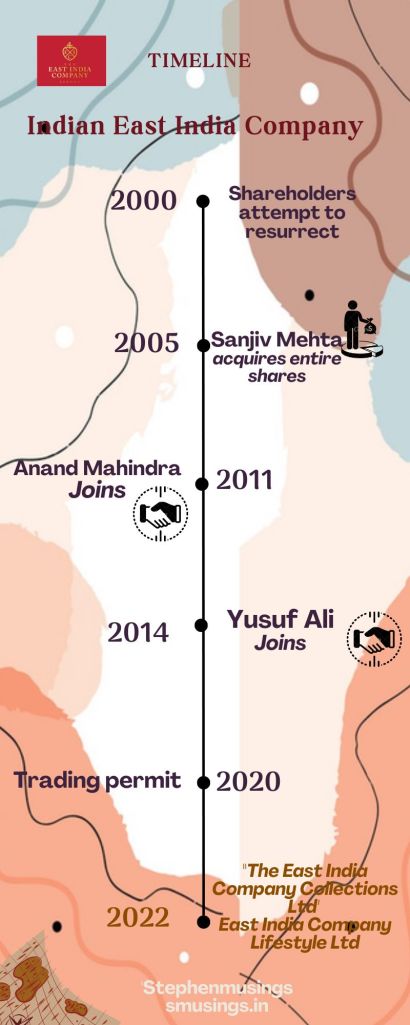
A small trace of the company persisted, comprising only its trade name and a modest business specializing in tea and coffee. In the early 2000s, they endeavoured to resurrect the company. Sanjiv Mehta, a Mumbai-born entrepreneur and an alumnus of IIM Ahmedabad, who had established himself in London, enthusiastically grabbed the opportunity. He embarked on a mission to reclaim and reshape the narrative of the company, he had learned about during his school days.
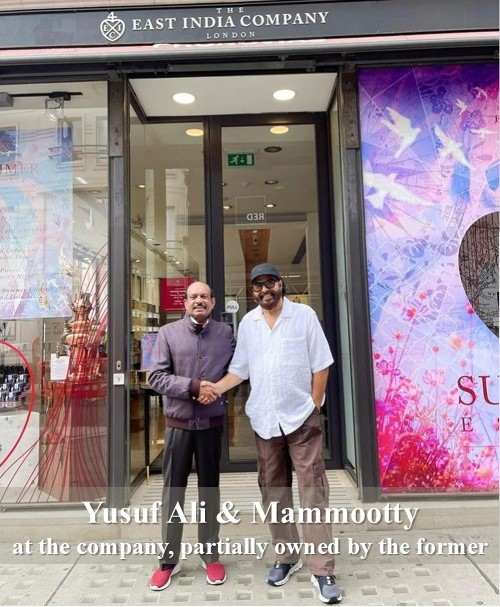
Through a series of acquisitions, Mehta emerged as the exclusive proprietor of the East India Company by 2005. Armed with the rights to trade using its historic name and coat of arms, he launched a 25-year strategy to metamorphose it into a luxury brand. In 2011, the company secured the authority to mint its own currency, a practice last exercised in 1918 during British India. Mehta also obtained replication rights for artifacts housed in museums worldwide, as well as the privilege to reproduce documents from the British era such as maps and literary materials. Renowned Indian entrepreneurs Anand Mahindra in 2011 and Yusuf Ali in 2014 joined this venture.
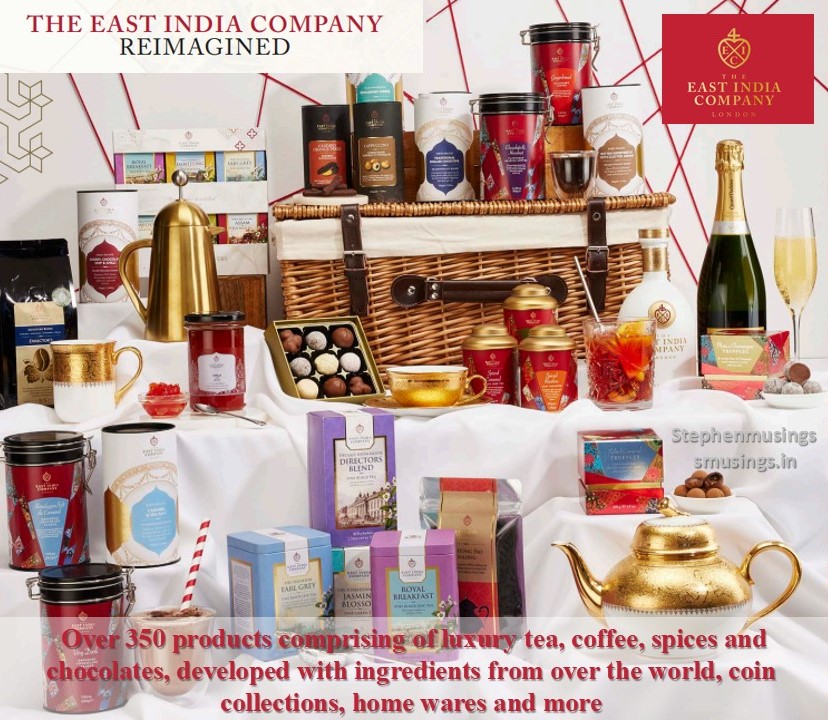
In 2020 with the issuance of his trading permit, Mehta successfully transformed the brand into a luxury tea, coffee, and gourmet food business operating from the United Kingdom. The Mayfair-based London store boasts an extensive inventory of over 350 products, which include, more than 100 varieties of tea, spices, chocolates meticulously crafted from ingredients sourced globally, coin collections, homewares, and more. Presently, the company operates with two subsidiaries: ‘The East India Company Collections Ltd’ and ‘East India Company Lifestyle Ltd’.
Anand Mahindra expressed his elation by tweeting “delighted to be part of turning history upside down. Something energizing about seeing THIS Company in Indian hands”
Sanjiv Mehta aptly noted, “A company which once owned India is now owned by an Indian … a feeling of the empire striking back.”
Undoubtedly, this achievement stands as a source of pride for India.
Reflections on this narrative include:
- In hindsight, the East India Company’s cruel actions and the subsequent colonization by the British Raj played a crucial role in uniting diverse regions within this subcontinent. These events activated a collective movement to expel the British from the region, ultimately leading to the consolidation of these territories into the modern nation of India.
- The famous saying “History repeats itself” holds true. However, we are witnessing a reversal of historical roles: the East India Company, which formerly held control over India, is now in the hands of Indians. And the country that once governed India, Britain, is now under the leadership of a person of Indian origin as its Prime Minister.
- Sanjiv Mehta is focusing on the process of reinvigorating a brand that has deep historical and emotional connections to politics, colonization, slavery, opium, warfare, and transnational trade. The purpose is to elevate the brand into a contemporary premium/luxury category, essentially shifting its perception from a negative association to a positive one. This case study of the new avatar of EIC is worthy of analysis and dialogue.
- The first joint-stock company in history, EIC, eventually grew to become the most influential and prosperous entity globally. To rein in its dominance, the British government intervened by enacting a series of Acts, leading to the eventual cessation of the company itself. This evolution continues today, with contemporary IT giants such as Apple, Microsoft, Meta, Alphabet, Amazon, and Alibaba exerting their global influence through distinct means. In response, successive nations are enacting novel regulations to govern the operations of the corporates. A Joint Stock Company is the creation of law and has to be governed and monitored by law, lest it becomes a Frankenstein, a monster that is beyond the control of its creators.

To view the video on this transformation of the company click here
To read the detailed history of the British East India co, click here
To gather the latest from the East India Co website, click here


 Stephen Musings
Leave a reply to C.P. John Cancel reply