
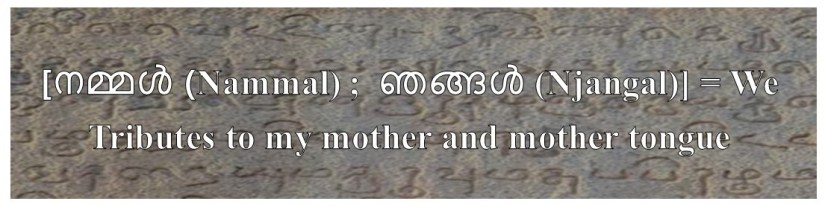
Language, the means of communicating feelings, thoughts, and information, is the greatest invention by human beings. Our ancestors were so ingenious that we have so many languages around us. We in India have 22 recognized languages, and across the globe, over 7000 languages. Each one of them is complete and unique in its own way.
There are some words in these languages, which cannot be replaced by words in other languages. Here is one instance from the Malayalam language. The two words നമ്മൾ (Nammal) and ഞങ്ങൾ (Njangal) have the same meaning ‘we’ in English, the most spoken language in the world, thanks to colonisation. But the two words have different meanings. I picked up the distinction between these two words from an early age from my mother.
My childhood. I was born sixth in a family of ten. My father’s elder brother died at an early age. And so, his family of six children also stayed with us. [1] Three daughters of my father’s sisters stayed with us to attend the St Joseph’s Girls High School, near the Metropolitan Church, Changanacherry. About 20 Children were residing under one roof in our home. We all grew up as one family. Our elder cousins mentored us and even disciplined us when required. My mother insisted on us using the word നമ്മൾ (nammal) and corrected us when we used the word ഞങ്ങൾ (njangal). So, we never had any factions among us and were all brought up as siblings. I remember as grown-up when I was introducing my cousin, he corrected “no, we are brothers.”
I bow my head in reverence and gratitude to my mother who brought us to be നമ്മൾ (nammal) and not ഞങ്ങൾ (njangal) and നിങ്ങൾ (ningal) of different families.
We pick up words early, without understanding the full gamut of their implications. No wonder the language we naturally and unconsciously learn at an early age is called the mother tongue.
Linguistic meaning
Examining the nuances of these words brought out their intricacies. Both of them are first-person plural pronouns. നമ്മൾ (Nammal) is inclusive and ഞങ്ങൾ (Njangal) is exclusive. നമ്മൾ (Nammal) when used by a person addressing someone else, includes the addressee or/and the group of people he belongs to counting himself part of the group. The pronoun നമ്മൾ (Nammal) engulfs everyone and so it’s an inclusive expression. ഞങ്ങൾ (Njangal) excludes the group addressed and denotes only the speaker /addresser and his or her group, thus is called ‘plural exclusive’.
To take a metaphor from the set theory in Mathematics, നമ്മൾ (Nammal) refers to the universe set, which contains all the elements or objects in a phenomenon under study. ഞങ്ങൾ (njangal) refers to a subset, where the rest is നിങ്ങൾ (ningal).

Use in other languages
Caldwell [1875], the Christian missionary, in his book on Dravidian languages stated that Tamil, Malayalam, Telugu, and Tulu, the modern Dravidian languages, [except Kannada] retain inclusive and exclusive first-person plural pronouns. [2]
Jim Chen [2006]in his research paper mentions Marathi, used in western India, as another language, besides the Dravidian languages that distinguish the inclusive and exclusive forms of first-person plural. He categorically states that the European languages including English draw no distinction between the inclusive and exclusive forms of the pronoun. [3]
Introspection: This makes us reflect on the culture that existed in ancient societies, especially in our country. People perceived everything from a wider perspective and considered themselves in an inclusive form, leaving out no one from the circle. The joint family system did foster this outlook. Nucleus families in vogue, the competitions making the entry from the kindergarten stage, prevailing cutthroat rivalry in the market, campaigning by political parties to gain more seats to gain a majority in a democratic system, and the media especially the social media opening the floodgates to express individual’s views, often ignoring the feelings of the viewers/readers… have all made us exclude the other. This leads to creating factions, intolerance, and hatred, within a family, society, and the world at large. Which results in killings, family feuds, social tensions, and wars.
If we count the number of times these words are used in our day-to-day life, we are sure to realise that the seldom used word is നമ്മൾ (nammal), often used word is ഞങ്ങൾ (njangal) against നിങ്ങൽ (ningal) and the most often used word, is ഞാൻ (“I”). Is this not a signal that we as a society are moving from Inclusive – to – exclusive – to – individualistic culture?
[1] To read the narrative on my childhood in Changanacherry market click here
[2] Robert Caldwell (Rev), Comparative Grammar Of The Dravidian Or South – Indian Family Of Languages. London : Trübner & Co. , Ludgate Hill. 1875.
[3] James Ming Chen, First Person Plural, Minnesota Legal Studies Research Paper No. 06-30 Michigan State University – College of Law, July 9, 2006
[4] To read the Malayalam version in Manorama online click here


 Stephen Musings
Leave a comment