
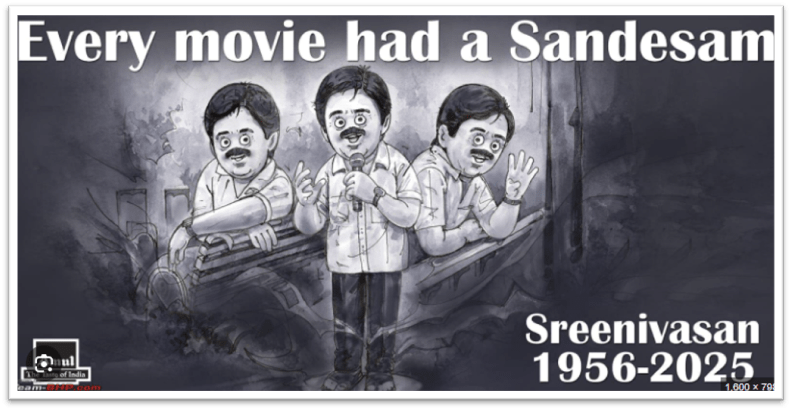
Sreenivasan, renowned actor, scriptwriter, and director, has passed away on 20 December 2025. He carved out a distinctive niche in the history of Malayalam cinema—a path truly his own. Throughout his career, he made, wrote, and acted in numerous films; a defining feature of his work was his use of self-deprecating humour, a style rarely seen before in the industry. His protagonists were often ordinary or even below-average individuals we might encounter every day. By highlighting their flaws and shortcomings, he encouraged audiences to laugh along with them, not at them. Sreenivasan’s approach marked a clear departure from traditional notions of a hero—his characters were not anti-heroes, but rather unique figures we can identify ourselves, who moved the story forward.
He provided a satirical take on Kerala society, reflecting its cultural, socio-economic, and religious dynamics. His films spanned a wide array of topics, including politics, trade unions, entrepreneurial struggles, marital relationships, and religious devotion.

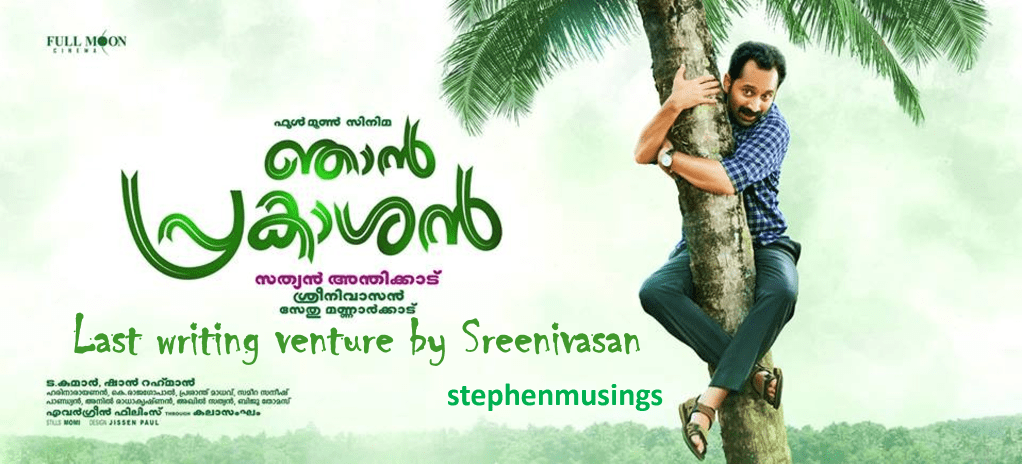
Notably, his last writing project, ‘Njan Prakashan,’ released in 2018 after a 16-year interval, explored the contemporary issues of career planning and youth psychology, making it relevant even today.
‘Njan Prakashan’ Directed by Sathyan Anthikad and Story, script and dialogue by Sreenivasan, presents a cartoon-like portrayal of the average contemporary Malayali youth. The protagonist’s defining traits include a fragile sense of self-worth, symbolised by the deliberate reinvention of his name from Prakash to P. R. Akash—and a tendency to pursue courses of study in which he has little genuine interest. He dreams of going abroad, idles away time in petty mischief, constantly searches for crooked and immoral means to success, and shows scant respect for agriculture as a viable livelihood. Equally telling is his condescending attitude towards migrant workers from other Indian states, revealing deeper social prejudices beneath the humour.
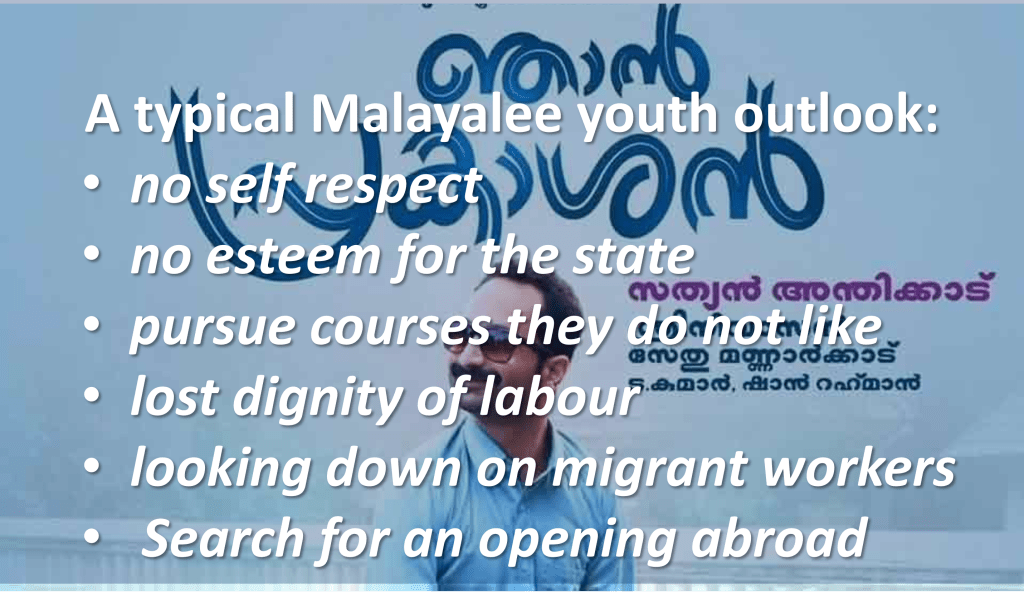
Plot Overview and Character Transformation
The film subtly addresses a range of social and personal issues through the journey of its protagonist, Akash. Guided by Sreenivasan’s nuanced narration, the story follows Akash as he navigates various challenges, each shaping his perspective and growth. Initially, Akash resorts to opportunistic behaviour, using his classmate from nursing college to migrate to Germany. He manages to fund this plan through dubious means and arranges a registered marriage with her, believing this would secure his future abroad. However, his scheme unravels when the marriage does not materialise, and the girl goes on to marry a foreign national in Germany.
Akash is compelled to live among migrant workers, which exposes him to their realities and culture. This experience marks a turning point, broadening his understanding and empathy. Subsequently, Akash takes up a job as a home nurse, caring for a difficult young girl, and learns the value of hard work and perseverance through this demanding role. His path crosses with an enterprising woman who runs a catering business, preparing food from produce grown on her own agricultural land. This encounter further challenges his earlier prejudices and assumptions about livelihood and dignity of work.
Eventually, Akash secures employment as a male nurse in a local hospital. Gradually, he finds satisfaction and pride in his work, embracing his professional identity. The film concludes on a non-clichéd, distinctive note: when someone addresses him as P. R. Akash, he corrects them, asserting, “I am Prakash,” thus reclaiming his original name and, symbolically, his true self. Thus the meaningful title of the movie “Njan Prakasan” ഞാൻ പ്രകാശൻ.
Overcoming Adversity and Embracing Change
The narrative of ‘Njan Prakashan’ is anchored in Akash’s personal evolution as he confronts various challenges and learns valuable lessons through adversity. Initially driven by escapist ambitions and a desire for easy success, Akash gradually shifts his perspective, choosing to work in Kerala in a profession that matches his qualifications. This decision marks a significant departure from his earlier outlook, as he begins to appreciate the contributions of migrant workers, accepts a woman who earns her living through agriculture, and ultimately regains his self-esteem—a transformation symbolised by his return to his original name, Prakashan.
Narrative Structure and Memorable Dialogues
Akash’s paradigm shift, though seemingly unconventional, is woven seamlessly through a series of well-coordinated events within the two-hour film. Sreenivasan’s dialogues stand out for their originality, natural flow, and contemporary wit, infusing the story with humour and authenticity. The film features scenes that prompt both reflection and laughter, such as the character’s unlikely climb up a coconut tree when chased by a dog, or his instinct to flee from bullies rather than confront them head-on—contrary to typical cinematic depictions. Akash’s tendency to embellish or fabricate tales for self-aggrandisement is also cleverly highlighted, especially when his stories are easily discernible as lies by a child. A notable and forward-looking moment in the film is the depiction of Bengali workers sowing paddy fields to the accompaniment of Bengali songs.
Box Office Success and Artistic Impact
Sreenivasan’s mastery in translating everyday ideas into engaging, popular cinema is evident in the commercial success of ‘Njan Prakashan,’ which grossed over Rs 50 crore—a record at the time of its release.
A Tribute to an Exceptional Artist
The absence of Sreenivasan is deeply felt, as he was a unique artist whose influence extended both on and off the screen, leaving a lasting impact on public life and Malayalam

Youth Challenges and the Path to Transformation

The film, through Sreenivasan’s masterful script, introduces a paradigm shift in these attitudes, encouraging a re-evaluation of what constitutes meaningful work and success.
However, addressing these deep-rooted perspectives is not a simple endeavour. It requires a concerted effort from parents, teachers, and leaders in social, political, and religious spheres to foster change and guide the younger generation towards greater self-worth and community appreciation.
 Stephen Musings
Leave a comment