

Champions Trophy: Origin and evolution
The ICC Cricket World Cup, held every four years since 1975, is the flagship event of ICC and the pinnacle of the sport of cricket. In 1998, the ICC introduced a shorter tournament to generate funds for developing the sport in non-Test-playing nations. The ICC Knock Out Trophy was later named the ICC Champions Trophy, an international One Day International (ODI) competition featuring the top men’s teams.
The number of participating teams fluctuated over the years, but from 2009, only the top eight teams based on ICC rankings qualified, making it a true Mini World Cup. Initially held every two years, the 2008 edition was postponed to 2009, after which the tournament shifted to a four-year cycle, with editions in 2013 and 2017. Discussions about discontinuing the Champions Trophy emerged after both events, and no tournament was held in 2021.
However, in November 2024, the ICC revived and rebranded the Champions Trophy, announcing Pakistan as the host for the 2025 edition. [Pakistan is the reigning champion, having won the tournament’s last edition in 2017]. Due to security concerns, India declined to travel to Pakistan. The ICC, in consultation with the Pakistan Cricket Board (PCB) and the Board of Control for Cricket in India (BCCI), reached an agreement to hold India’s matches at a neutral venue, which was later confirmed to be Dubai.
Marketing by ICC
The Champions Trophy tour began in the second half of November 2024 in Islamabad, traveling across various cities in Pakistan before making its way through the eight participating nations. The global trophy tour concluded in India in January 2025 before returning to Pakistan.

To fund the tournament, the ICC partnered with several international business houses. The list of sponsors elicited mixed reactions—both appreciation and concern. On a positive note, Sobha Realty, the international luxury developer owned by Keralite entrepreneur PNC Menon, was named a global partner. However, the inclusion of Royal Stag, a liquor brand, as an official supporter raised concerns, particularly since alcohol, liquor, and pan masala brands are prohibited from sponsoring sports events in India.
Sponsors were categorized into three tiers, likely based on their financial contributions, with their visibility on the field adjusted accordingly. Additionally, their names appeared in rotation on the LED advertisement boards surrounding the boundary rope.
During the telecast, viewers saw advertisements for five brands under Pernod Ricard, Royal Stag’s parent company—Blenders Pride Fashion Tour, Glitz and Glamour, Jameson, Ballantine, and Chivas. Meanwhile, Coca-Cola organized a halftime entertainment event during the innings break of the final match.
Sponsors enjoyed substantial exposure, as the India vs. New Zealand final drew a record-breaking viewership of 90 Crores. The next highest viewership, 60 Crores, was recorded during the India vs. Pakistan match.
Review of Matches
From 19 February to 9 March 2025, fifteen matches were played across three stadia in Rawalpindi, Karachi, and Lahore in Pakistan and all India matches in Dubai. Three of the matches in Pakistan were abandoned due to rain.
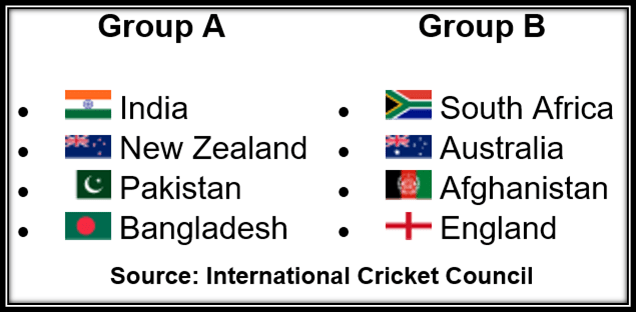
The eight top teams were grouped into A and B for the initial stage.
During the tournament, there were eight innings of over 300 runs, and Australia set a new record by successfully chasing 351 runs in ICC matches. In terms of individual milestones, ten centuries were scored, all during the round-robin stage. Afghanistan’s Ibrahim Zadran registered the highest individual score in Champions Trophy history with 177 runs.
The group stage determined the semi-finalists: India vs. Australia (Group A leader vs. Group B runner-up) and South Africa vs. New Zealand (Group B leader vs. Group A runner-up).
India’s Dominance in the Tournament
India displayed an unassailable march to the title, winning all five of its matches convincingly.
Group Stage:
In their opening match, India bowled out Bangladesh for 228 and comfortably chased the target with 3.3 overs to spare, winning by six wickets.
Against arch-rivals Pakistan, India restricted them to 241 before chasing the target in 42.3 overs with six wickets in hand.
In the final group match against New Zealand to decide the top spot, India posted 249/9 in 50 overs and bowled out New Zealand for 204, securing a 44-run victory.
Knockouts:
Semi-final: In a high-stakes clash against Australia, India bowled them out for 264. Chasing the target, India secured the win with 11 balls and four wickets remaining.
Final: New Zealand set a competitive total of 251/7 in 50 overs, marking the first time in the tournament that India’s opponent was not bowled out. India successfully chased the target on the last ball of the 49th over, winning by four wickets with an over to spare.
India’s team effort
Indian players did not top the batting or bowling charts, nor was any of them named Player of the Tournament. However, half of the players in the ICC Men’s Champions Trophy 2025 Team of the Tournament, announced a day later, were from India.
India’s triumphant journey was not driven by individual brilliance but by a cohesive team effort, where every player contributed to the success of each match. The six bowlers vyed with each other to take wickets. While batting, each member was entrusted with a specific role, executing it with confidence and took calculated risks while trusting their teammates down the batting order.
This collective approach set India apart from New Zealand in the final. While India maintained faith in its players to follow, New Zealand struggled in the middle order, lacking the same trust in their lineup. Ultimately, Team India can take pride in the remarkable collective effort that led to their victory.
India’s Historic Triumph
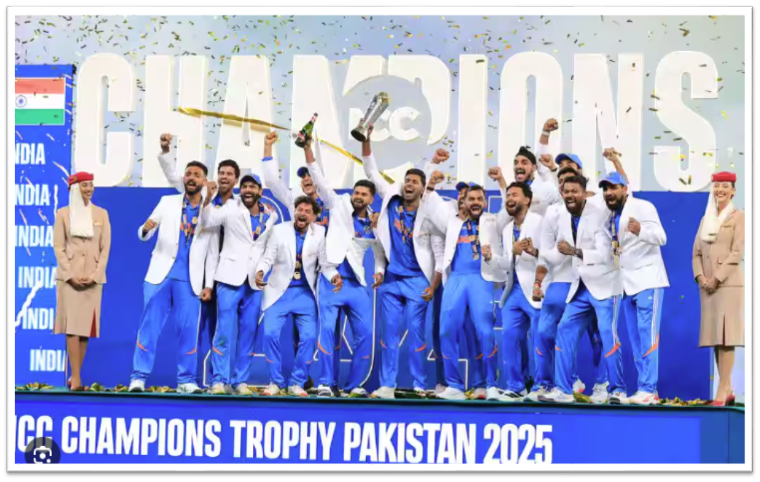
With this victory, India lifted the Champions Trophy for the third time (2013, 2025), including being joint winners in 2002, making them the most successful team in the tournament’s history. This win also marked India’s second consecutive ICC tournament triumph within just eight months and ten days, following their unbeaten run in the ICC Men’s T20 World Cup 2024.
India’s Influence beyond the Field
India’s dominance extended beyond the cricket pitch, shaping the very structure of the tournament. Although Pakistan was officially designated as the host, India’s firm refusal to play there led to a scheduling of the venues. All of India’s matches were moved to Dubai. Even the final’s location was conditional—if India reached the final, it would be held in Dubai; otherwise, in Lahore. Has any major international sporting event ever been arranged in such a manner?
This unprecedented scheduling was largely driven by viewership dynamics, with Indian audiences making up the majority of the tournament’s spectators. It also underscored the Board of Control for Cricket in India’s (BCCI) considerable influence over the International Cricket Council (ICC). While other teams crisscrossed over 7,000 kilometers between Pakistan and Dubai, the Indian squad enjoyed the luxury of a short commute from their hotel in Dubai to the stadium.
India’s presence at the trophy presentation was striking. Among those in attendance were ICC Chairman Jay Shah—who assumed office in December 2024, after the tournament’s scheduling had been finalised- BCCI President Roger Binny, and BCCI secretary Devajit Saikia. Notably absent were officials from the Pakistan Cricket Board (PCB), the designated hosts of the 2025 Champions Trophy.
The off-field drama does not diminish the Indian team’s cricketing brilliance as they continue to look ahead to a bright and promising future.
Introspection:
Indian cricket is on a remarkable rise. The Indian Premier League (IPL) continues to attract more viewers and players, fueling the sport’s upward trajectory in the country. Today, India can field three separate teams for the three formats and still have a wealth of talent waiting for their opportunity—a testament to the incredible depth of its cricketing pool.
The financial allure of the game is drawing more young aspirants, while the Board of Control for Cricket in India (BCCI) enjoys an ever-expanding treasury. As the richest cricket board in the world, BCCI’s wealth is reportedly six times greater than that of the next nine boards combined.
The following questions come to mind:
Can money alone sustain the passion and quality of the sport in the long run?
Isn’t the IPL, along with its associated games of chance, fostering corruption and unethical ways to make money?
Is it not having a detrimental impact on other sports in India?

 Stephen Musings
Leave a comment