
The World Happiness Report 2024 was released by the University of Oxford’s Wellbeing Research Centre, on March 8, 2024. This longitudinal study, initially launched in 2012 under the auspices of the UN, utilizes data primarily sourced from the Gallup World Poll. Participants in this poll assess their overall life satisfaction using a symbolic ladder, with 10 being the best possible life and 0 being the worst. Referred to as the Cantril ladder, respondents provide numerical responses on this scale. Typically, approximately 1,000 responses are collected annually from each country. The world happiness ranking is made by averaging these life evaluations over three years. Consequently, the rankings for 2024 are derived from the average life evaluations gathered from 2021, 2022, and 2023.

This year, Finland leads the Cantril ladder with a score of 7.74 out of 10, while Afghanistan has the lowest score of 1.72. Finland maintains its position at the top for the seventh consecutive year, and as expected, all Nordic countries secure spots in the top ten. Israel, which was surveyed after October 7, 2023, has slipped from fourth to fifth place. India, with a score of 4.05, holds onto its 126th rank from 2023.
Notably, the top 10 countries no longer include any of the largest nations. Among the top ten, only the Netherlands and Australia have populations exceeding 15 million. The evaluation of happiness, as measured by one’s life satisfaction, is influenced by various factors closely tied to culture. Smaller, more cohesive groups tend to reflect this better than larger, more dispersed populations across vast territories.
This point was underscored by a longitudinal study conducted by the McKinsey Global Institute, spanning over 40,000 micro-regions and cutting across national perspectives. The study revealed pockets of progress in terms of wealth and health across the globe. In India, regions such as parts of Kerala and Goa were identified as progressive as some areas in developed countries. To read on the McKinsey study click here. A study on happiness following a similar approach could yield more meaningful insights.

The World Happiness Report is mainly seen as a source for ranking nations. But the report goes far beyond and offers deeper insights. This year, the analysis of responses by age draws attention to a diverse perspective from the prevailing belief. It was commonly held that youth experience peak happiness, followed by a decline until middle age, and then a significant rebound. A meta-analysis of data from 145 countries reveals a U-shaped relationship between age and life satisfaction in most countries, including 109 developing nations. This change in happiness levels across the human life cycle can be visualized by the ‘mouthline’ of a happy emoji.

The 2024 report draws our attention to the fact that in many regions, the young indeed report higher happiness levels than the elderly. However, in North America, youth happiness has declined to the extent that they are now less happy than the older population. Conversely, in the transition countries of Central and Eastern Europe, the youth are considerably happier than their older counterparts. Western Europe, on the whole, shows similar levels of happiness across all age groups, while elsewhere happiness tends to decrease over the life cycle, with occasional spikes among the elderly. Worldwide, the trend is a decline throughout the life cycle, with distinct happiness trajectories for males and females.

A Chapter on a study conducted in India: Within this 158-page report, the final and the fifth chapter, spanning 30 pages, is exclusively devoted to India under the heading: “Differences in Life Satisfaction among Older Adults in India.” A comprehensive study was conducted among older individuals in India, and its findings are presented in this chapter. The study finds that older age is associated with higher life satisfaction in India, challenging assertions that the positive correlation between age and life satisfaction is only seen in high-income nations, while satisfaction declines with age in socioeconomically constrained countries.
The study reveals that older men, those in higher age brackets, those currently married, and individuals with education report higher life satisfaction compared to their counterparts. Factors such as dissatisfaction with living arrangements, perceived discrimination, and poor self-rated health significantly correlate with lower life satisfaction among older Indians.
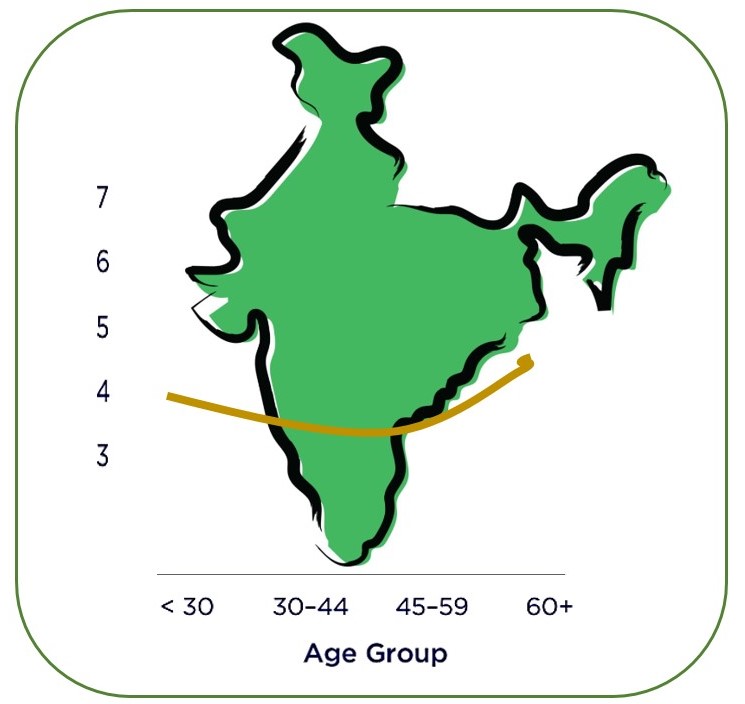
The study’s findings suggest that strengthening family networks to ensure comfortable living arrangements for older adults, especially for men, widowed individuals, and those without formal education, alongside bolstering social networks to reduce discrimination, may enhance well-being in older age.
To read the World Happiness Report 2024, click here
Afterword: One of my former students inquired, isn’t Bhutan the happiest nation in the world? A perusal of the World Happiness Report 2024 fails to find Bhutan, while its neighboring country Nepal ranks 93rd. It was Bhutan’s 4th King, Jigme Singye Wangchuck, who coined the term Gross National Happiness (GNH) in 1972, emphasizing it over GDP. The World Happiness Report 2023 acknowledges Bhutan’s significant contribution, crediting Jigme Thinley, the former Bhutanese Prime Minister, for advocating the study of GNH and introducing the 2011 UN Resolution, which led to the inception of the first World Happiness Report. It seems ironic that Bhutan, the originator of this concept, is not mentioned in the recent report. This issue is discussed in the article titled “Bhutan is the Happiest Country in the World?” To read the article click here


 Stephen Musings
Leave a comment