
The journey of R Praggnanandhaa, fondly known as Pragg, the 18-year-old Indian chess prodigy, to the title of the world championship, was halted only by Magnus Carlsen, the reigning champion. This remarkable accomplishment instills pride in every Indian. Are you aware that chess has its origin in India? Let’s delve into the tale, from the birth of the game to the triumph of Pragg.
Origin of the game of chess:
With the earliest documented reference, the origin of chess is traced back to the Gupta Empire, in the sixth century AD in northern India. Initially known as ‘Chaturanga,’ a Sanskrit term meaning “four-limbed” or “four arms,” it referred to ancient military divisions: infantry, cavalry, elephantry, and chariotry. This early form of the game was simulated to draw out ancient Indian military strategies.
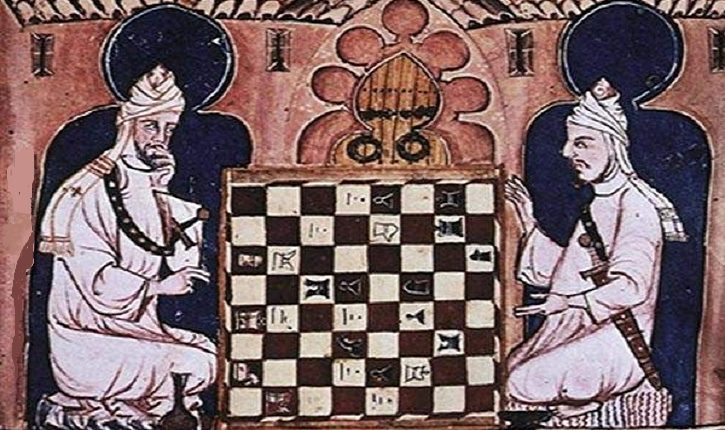
From northern India, chess subsequently spread to Persia, where it adopted the name ‘Shatranj,’ reflecting its Sanskrit roots. The game also reached China during the Han Dynasty. As the Muslims came to power in Persia, they embraced and adapted chess, eventually introducing it to Europe during the Moorish Conquest of Spain. In Europe, the game evolved, with the chariotry and elephantry pieces being replaced by the rook and bishop. This transformation gave rise to the modern chess pieces we know today, including the king, queen, bishop, rook, pawn, and knight. In Indian vernacular languages, the four chess pieces are still referred to as elephant, chariot, infantry, and horse.
Chess continued to grow in popularity worldwide, leading to the standardization of chess sets in the mid-19th century. Competitive sport as we recognize it today emerged in the latter half of the 19th century. The United Nations estimates that nearly 605 million people, or approximately 8% of the global population, regularly engage in this timeless pastime. UN describes the game thus “Chess is one of the most ancient, intellectual and cultural games, with a combination of sport, scientific thinking and elements of art. As an affordable and inclusive activity, it can be exercised anywhere and played by all, across the barriers of language, age, gender, physical ability, or social status.
World Championship:
The International Chess Federation (FIDE) was established in 1948, and it assumes the responsibility of organizing the World Chess Championships. The event was conducted as a single tournament in 1948, thereafter, a recurring 3-year cycle was introduced.
For a significant portion of this period, players from the Soviet Union and Russia held the world championship title, with only two exceptions. Throughout the 20th century and into the early 21st century, Chess luminaries such as Mikhail Botvinnik, Vassily Smyslov, Mikhail Tal, Tigran Petrosian, Boris Spassky, Anatoly Karpov, Garry Kasparov, and Vladimir Kramnik stood as world champions.

Bobby Fischer, an enigmatic figure from America, emerged as the sole player who managed to breach the formidable Soviet chess stronghold. During the period 1970 to 1972, Fischer’s reign seemed unassailable. The zenith of this era was the 1972 match between Fischer and Spassky, a contest that captured global attention, even reaching those with no prior knowledge of chess. This event not only stood as the most anticipated world chess championship in history but also carried significant geopolitical implications, as the United States and the Soviet Union were locked in the Cold War.
Over the years, we witnessed world champions hailing one each from Ukraine, Uzbekistan, and Bulgaria, adding diversity to the nationality of titleholders.
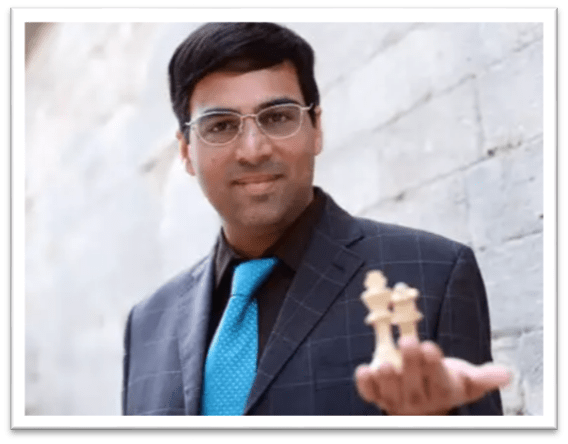
Vishwanathan Anand of India made his presence in the world championship by finishing as the runner-up in 1995 and continued his participation until 2014. Over this period, Anand secured the title of world champion five times during 2000 – 2013. He also reached the runner-up position five times. His last two attempts were met with defeat by Magnus Carlsen in 2013 and 2014.
In 2013, Magnus Carlsen from Norway unseated Vishwanathan Anand to capture the championship, and he went on to successfully defend the title for the sixth consecutive time, defeating Pragg on August 23, 2023.

Praggnanandhaa, true to his unique name, has a remarkable story of his own. Born in Chennai to a lower-middle-income family in 2005, he drew inspiration from his elder sister, who was passionately pursuing chess and later became a grandmaster in 2018 and an international master in 2021. Pragg’s journey began at the age of six when he clinched gold at the Asian Championships. He continued his ascent by securing World Youth Chess Championships titles for the under-8 and under-10 categories. At just 10 years old, he earned the title of international master, becoming the youngest-ever achiever of this distinction. By the age of 12, he became a grandmaster, making him the second-youngest grandmaster at that time.
Ranked 29th in the world, Pragg had defeated Magnus Carlsen, the reigning champion, not once but twice in the last year. The first victory occurred on February 22, 2022, at the Airthings Masters Tournament, where Pragg became the youngest player to defeat Carlsen. He repeated this feat on May 20, 2023, at the Chessable Masters Online Tournament.

At the 2023 Chess World Cup tournament held in August in Baku, Azerbaijan, 18-year-old Pragg was the youngest player in history to reach the Chess World Cup final. Pragg’s dominance in the tournament was impressive, as he surpassed the world’s third and second-ranked players. His journey was only terminated by Magnus Carlsen, the reigning champion since 2013, that too, in a tiebreaker-rapid game. Despite finishing as the runner-up, Pragg’s achievement was commendable.
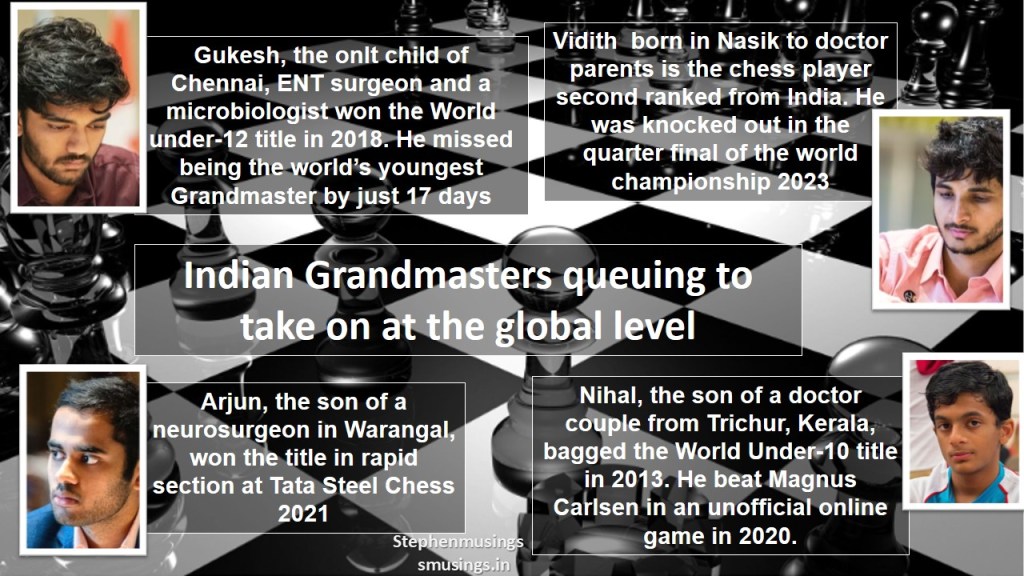
Another outstanding aspect of this year’s competition was the presence of four Indians in the quarter-finals. They were, including Pragg, D. Gukesh, Arjun Erigaisi, and Vidit Gujrathi. Magnus Carlsen, the champion, in his post-match press conference, praised the young talents, particularly highlighting Gukesh’s strength, remarking that “Gukesh is extremely strong and was somewhat unlucky to have faced me on a day when I was at my best.” He also noted that “Gukesh is clearly the strongest classical player right now.” Carlsen expressed confidence in the future of chess, stating, “What I think is pretty clear is that chess is in good hands for the future. The generation of players born from 1990-1994 has dominated for a long time, and finally now, with these youngsters born in 2003 and after, we have a generation that’s worthy of succeeding us.”

These significant accomplishments fill every Indian with pride, not only because of Pragg but also because they symbolise a bright and promising future for India, the womb of this enchanting game. Chess, originally devised as a tool for monarchs to strategize for battle, has evolved into an invigorating and intellectual sport that welcomes participants from all walks of life, regardless of their nationality, or physical abilities.


 Stephen Musings
Leave a comment